OpenAI Raises $122 Billion: The Dawn of the AI Superapp Era
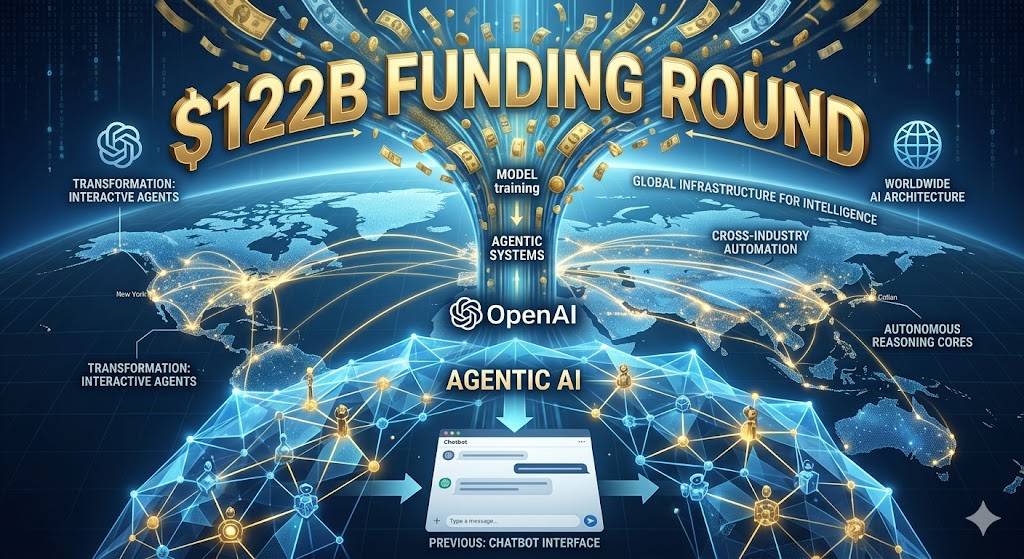
A deep analysis of OpenAI's record-breaking $122B funding round and its pivot toward 'Agentic AI'—transforming from a chatbot into the global infrastructure for intelligence.
The Biggest Infrastructure Play in History
On March 31, 2026, OpenAI closed a historic funding round, raising $122 billion at a post-money valuation of $852 billion. Backed by heavyweights like Microsoft, SoftBank, and Amazon, this isn't just a corporate milestone—it's a signal that Artificial Intelligence has moved from the "experimental tool" phase to the "utility infrastructure" phase, comparable to the advent of the electrical grid.
The "Flywheel" Strategy
OpenAI's growth is no longer linear; it's a reinforcing flywheel. The announcement detailed a simple yet massive economic loop: Compute drives Intelligence -> Intelligence drives Products -> Products drive Adoption -> Adoption drives Revenue -> Revenue buys more Compute. With monthly revenue now hitting $2 billion—growing four times faster than the early days of Google or Meta—OpenAI is proving that the massive upfront cost of compute is already paying structural dividends.
From Chatbot to AI Superapp
The most significant revelation in this update is the shift toward "Agentic AI" and the development of a Unified AI Superapp. OpenAI acknowledges that users are tired of fragmented tools. The next phase centers on systems that don't just "talk" but "act"—reasoning across applications, workflows, and private data to complete complex tasks end-to-end with minimal human intervention. GPT-5.4 is already paving the way, showing record engagement in agent-driven tasks.
Personal Perspective: The Infrastructure of Intelligence
In my evaluation, we are witnessing the birth of the "Intelligence Layer." Just as we don't think about where our electricity comes from, OpenAI aims to be the invisible force powering every business and consumer workflow. By securing massive compute capacity (2 gigawatts for Trainium alone), they have built a moat that competitors will find nearly impossible to cross. The true challenge now isn't intelligence—it's usability. The company that makes AI as easy to use as a light switch will own the next decade of the global economy.