ChatGPT & Mental Health — OpenAI's Most Sensitive Challenge Yet
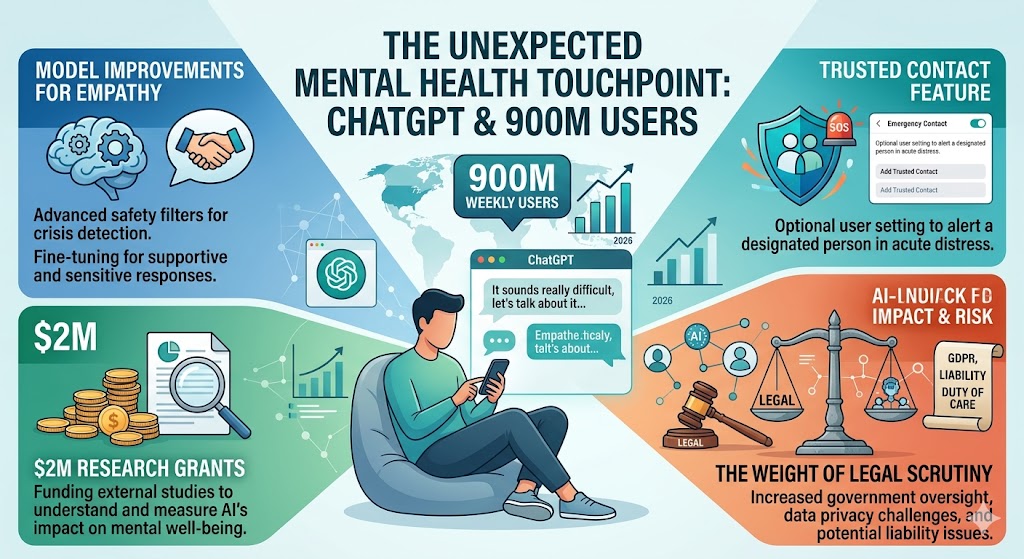
With 900 million weekly users, ChatGPT has become an unexpected mental health touchpoint. OpenAI is responding with model improvements, a Trusted Contact feature, $2M in research grants — and the weight of real legal scrutiny.
The Scale of the Problem
More than 900 million people use ChatGPT every week. At that scale, even rare events become large numbers. OpenAI estimates that around 0.15% of weekly active users — roughly 1.2 million people — have conversations involving explicit indicators of potential self-harm. Another 0.07% show possible signs of psychosis or mania. These aren't edge cases anymore. They're a category that demands structured, expert-informed responses.
The challenge is one that no AI company has fully solved: how do you build a general-purpose conversational AI that remains genuinely helpful across billions of interactions, including the ones where someone is in genuine distress?
What OpenAI Has Built So Far
Working with more than 170 mental health clinicians and a Global Physician Network of 300 specialists, OpenAI has trained ChatGPT to better recognize signs of distress and respond with more care. The result: a 65–80% reduction in undesirable responses in sensitive mental health scenarios since the October 2025 model update. The improvements cover three focus areas:
- Mental health emergencies — psychosis, mania, and non-suicidal crises
- Self-harm and suicide — better detection of indirect signals, not just explicit statements
- Emotional reliance on AI — preventing unhealthy attachment patterns from forming
OpenAI has also updated its Model Spec to make these goals more explicit: the model should support users' real-world relationships, avoid affirming ungrounded beliefs that may relate to emotional distress, and pay closer attention to indirect signals of risk.
The Trusted Contact Feature
The most significant new product feature is Trusted Contact — rolling out globally now. It works like this: users go into ChatGPT settings and designate one person they trust, such as a friend, family member, or caregiver. That person has one week to accept. Once they do, if ChatGPT's automated systems flag a conversation for potential self-harm risk, a small team of trained human reviewers assesses the situation — with a target review time of under one hour. If reviewers determine there's a genuine concern, the trusted contact receives a brief notification by email, text, or in-app alert.
It's a thoughtful feature, but not a simple one. Some users turn to AI precisely because they want privacy from the people in their lives. A notification feature is a real tradeoff — and OpenAI has been upfront about that tension.
New Evaluation Methods
Beyond product features, OpenAI is strengthening its safety infrastructure. New evaluation methods now simulate extended mental health-related conversations — the kind that may start innocuously and only reveal distress patterns after many exchanges. This addresses a known limitation: safety guardrails that work well in short conversations can degrade over long ones. The new evaluations help identify these failure modes before deployment.
Emotional reliance and non-suicidal mental health emergencies have also been added to OpenAI's standard baseline safety testing for all future model releases — meaning these aren't one-off fixes, they're now permanently part of how new models get evaluated before launch.
$2 Million in Research Grants
Recognizing that internal safety work alone isn't enough, OpenAI opened a call for external research proposals focused on AI and mental health. Grants range from $5,000 to $100,000, with a total pool of up to $2 million. The program prioritizes interdisciplinary teams that combine technical AI expertise with mental health experience and lived experience — a recognition that the people most affected by these interactions should have a voice in shaping them.
The Legal Pressure
This work doesn't exist in a vacuum. A number of mental health-related lawsuits involving ChatGPT have been filed, and a California court has recently coordinated several of these cases into a single proceeding. OpenAI has committed to handling these cases with care and transparency, while maintaining that its ongoing safety work continues independently of litigation.
The legal scrutiny is uncomfortable, but it's also clarifying. It forces a company building at unprecedented scale to be accountable — not just to users, but to families and communities who may bear the consequences of decisions made in engineering and product meetings.
The Honest Assessment
OpenAI deserves credit for the seriousness with which it's approaching this. The collaboration with clinicians, the public reporting of safety metrics, the research grant program, and the Trusted Contact feature all reflect genuine effort. But a 65–80% improvement in lab evaluations is not the same as a 65–80% improvement in real-world outcomes — and independent clinical audits don't yet exist to bridge that gap. The work is real; the work is also incomplete. And at 900 million users a week, the stakes of that gap are very high.