OpenAI Frontier — The Enterprise Platform That Treats AI Like a New Employee
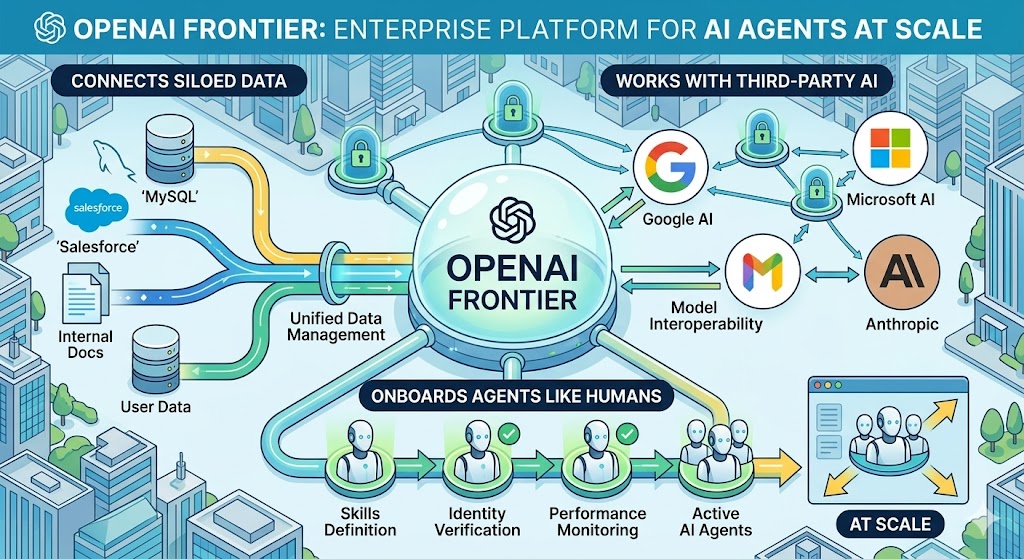
OpenAI has launched Frontier, an enterprise platform for building, deploying and managing AI agents at scale. It connects siloed data, onboards agents like humans, and works with third-party AI from Google, Microsoft, and even Anthropic.
The Problem Every Enterprise Knows Too Well
Most companies have deployed AI in some form. But those deployments tend to be isolated — a chatbot here, an automation there — disconnected from the systems where actual work happens. "What's really missing still, for most companies, is just a simple way to unleash the power of agents as teammates that can operate inside the business without the need to rework everything underneath," said Denise Dresser, OpenAI's Chief Revenue Officer. Frontier is OpenAI's answer to that gap.
What Frontier Actually Is
OpenAI Frontier is an enterprise platform for building, deploying, and managing AI agents that can do real work across an organization. The core idea: give AI agents the same things you'd give a new human employee — shared context about how the business works, an onboarding process, a feedback loop for improvement, and clear permissions about what they can and can't do.
Frontier acts as an intelligence layer that stitches together disparate systems — CRM tools, ticketing platforms, data warehouses, internal applications — so that AI agents have a unified view of the business, not just isolated data snapshots.
Designed to Work With What You Already Have
One of Frontier's most important design decisions is openness. "Frontier is really a recognition that we're not going to build everything ourselves," said Fidji Simo, OpenAI's CEO of Applications. The platform is compatible with:
- Agents built by OpenAI
- Agents that enterprises build in-house
- Third-party agents from Google, Microsoft, and Anthropic
This matters enormously in practice. Most enterprises aren't going to rip and replace their existing AI investments — they need a platform that works with the ecosystem they've already built, not one that forces lock-in.
How Agents Are Managed
Frontier introduces a model of agent management that mirrors how companies manage people. Agents go through an onboarding process, build memories from past interactions, and improve over time through feedback loops — similar to how a performance review helps an employee develop. Permissions are scoped precisely: each agent gets access to exactly what it needs for each task, nothing more.
Enterprise Identity and Access Management (IAM) applies across both human employees and AI agents, so governance doesn't require separate systems. Built-in monitoring and detailed audit logs provide full traceability — critical for regulated industries where accountability can't be an afterthought.
The Data Behind the Gap
OpenAI's own B2B Signals research reveals a widening divide between frontier enterprises and typical ones. Frontier firms now use 3.5x as much AI intelligence per worker as typical firms — up from 2x a year ago. Crucially, message volume explains only 36% of that gap; the majority comes from deeper, more complex AI use. Frontier firms send 16x as many Codex messages per worker as typical firms. The advantage isn't about having more seats — it's about embedding AI into actual workflows.
Early Customers and Alliance Partners
HP, Oracle, State Farm, and Uber are among the early enterprises piloting Frontier. On the consulting side, OpenAI has formed Frontier Alliances with BCG, McKinsey, Accenture, and Capgemini — bringing in partners who can handle the strategy, change management, and workflow redesign that technical platforms alone can't deliver.
"AI alone does not drive transformation. It must be linked to strategy, built into redesigned processes, and adopted at scale with aligned incentives and culture to deliver sustained outcomes," noted BCG in the announcement — a refreshingly honest acknowledgment that deploying Frontier is only part of the challenge.
The Enterprise Ambition
OpenAI's CFO Sarah Friar has said enterprise customers currently account for roughly 40% of OpenAI's business — with a target of reaching 50%. Frontier is the clearest signal yet that OpenAI is serious about competing in the enterprise layer, not just the consumer one. The platform arrives at a moment when agentic AI is moving from experiment to expectation in corporate environments.
Whether Frontier can win against established enterprise players — Salesforce's Agentforce, Microsoft's Copilot Studio, ServiceNow's AI platform — will depend less on the technology and more on whether OpenAI can become the kind of trusted enterprise partner that procurement teams and CIOs are willing to bet their infrastructure on. That's a different kind of challenge than building a great model.