OpenAI Prism — The AI Workspace Built for Scientific Breakthroughs
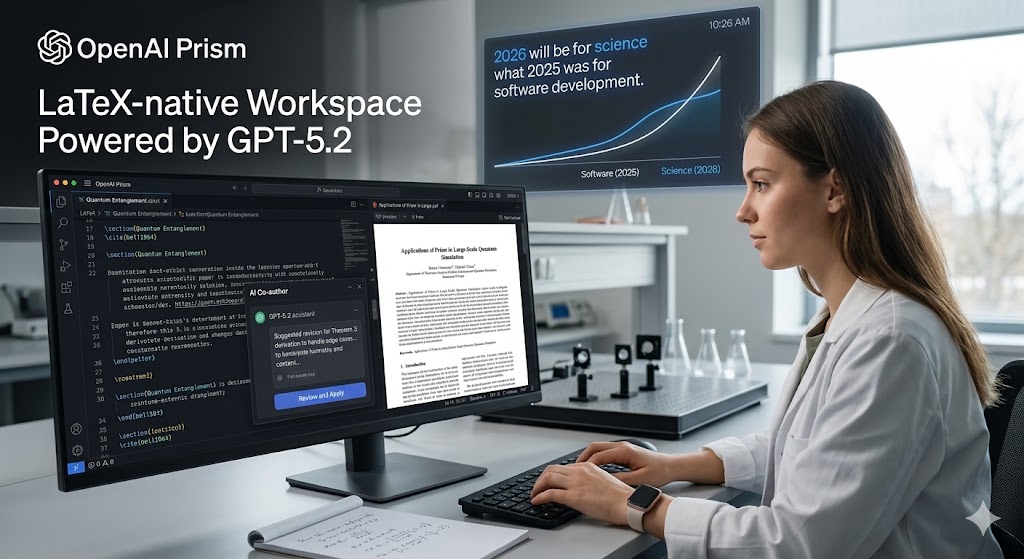
OpenAI has launched Prism, a free LaTeX-native workspace powered by GPT-5.2 that embeds AI directly into scientific writing. The bet: 2026 will be for science what 2025 was for software development.
The Bold Prediction
"I think 2026 will be for AI and science what 2025 was for AI and software engineering," said Kevin Weil, Vice President of OpenAI for Science, at the launch event. That's not a modest claim. In 2025, tools like Cursor and Windsurf fundamentally transformed how developers write code. OpenAI is betting that Prism will do the same for scientific research.
What Prism Actually Is
Prism is a free, AI-native workspace for scientists to write and collaborate on research, powered by GPT-5.2. It offers unlimited projects and collaborators and is available today to anyone with a ChatGPT personal account. The platform brings drafting, revision, collaboration, and preparation for publication into a single, cloud-based, LaTeX-native workspace.
Rather than operating as a separate tool alongside the writing process, GPT-5.2 works within the project itself—with access to the structure of the paper, equations, references, and surrounding context. This isn't a chatbot sitting next to your LaTeX editor — it's AI embedded in the document structure itself.
Built on Crixet, Made Free
Prism builds on the foundation of Crixet, a cloud-based LaTeX platform that OpenAI acquired and has since evolved into Prism as a unified product. By acquiring mature infrastructure rather than building from scratch, OpenAI started with a strong base and focused integration efforts on making AI feel native to scientific workflows.
The pricing model is deliberate: Prism is completely free — no subscriptions, no seat limits, no project caps. More powerful AI features will be made available through paid ChatGPT plans over time. But the core workspace remains accessible to anyone, which removes the institutional procurement friction that often slows research tool adoption.
What It Can Do
Prism supports:
- Full LaTeX editing in the browser — no local installation, no environment management
- Real-time collaboration with unlimited co-authors, eliminating version conflicts
- Project-aware AI that understands the full context of your manuscript, including past drafts
- Literature search and citation management with Zotero integration
- Visual capabilities — convert whiteboard sketches and drawings into polished LaTeX diagrams
- Equation conversion and formatting automation to reduce repetitive LaTeX work
Perhaps the most powerful feature comes from combining the usual powers of an AI model with more rigorous context management. When users open up a ChatGPT window through Prism, the model can access the full context of the research project, making responses both more germane and more intelligent.
The Demand Was Already There
Over the past year, OpenAI has seen AI accelerate scientific work across domains. ChatGPT receives an average of 8.4 million messages a week on advanced topics in the hard sciences. That's not a hypothetical use case — researchers were already turning to ChatGPT for help with their work. Prism formalizes and deepens that behavior.
Early Scientific Wins
In mathematics, AI models have solved several long-standing Erdős problems through literature analysis and new applications of existing techniques. A statistics paper published in December used GPT-5.2 Pro to establish new proofs for a central axiom of statistical theory, with human researchers responsible only for prompts and verification. These aren't just impressive demos — they're published results that demonstrate AI's growing role in actual scientific discovery.
Not a Replacement, an Accelerator
Kevin Weil's mission isn't to see GPT-5 make a single stunning discovery. "I think more powerfully—and with 100% probability—there's going to be 10,000 advances in science that maybe wouldn't have happened or wouldn't have happened as quickly, and AI will have been a contributor to that." The goal isn't to replace scientists — it's to remove the mechanical friction that slows them down.
Prism positions itself as the research equivalent of Cursor for coding: not replacing human judgment, but accelerating the parts of the process that don't require it.
The Deeper Bet
If Prism succeeds, it won't be because AI wrote better papers — it will be because thousands of researchers moved faster, published sooner, and spent less time wrestling with LaTeX formatting and more time thinking about their actual science. That's the same shift that made AI coding assistants transformative in 2025. Whether it translates to scientific research in 2026 is the question OpenAI is now betting on.