GPT-5.3-Codex — The AI That Helped Build Itself
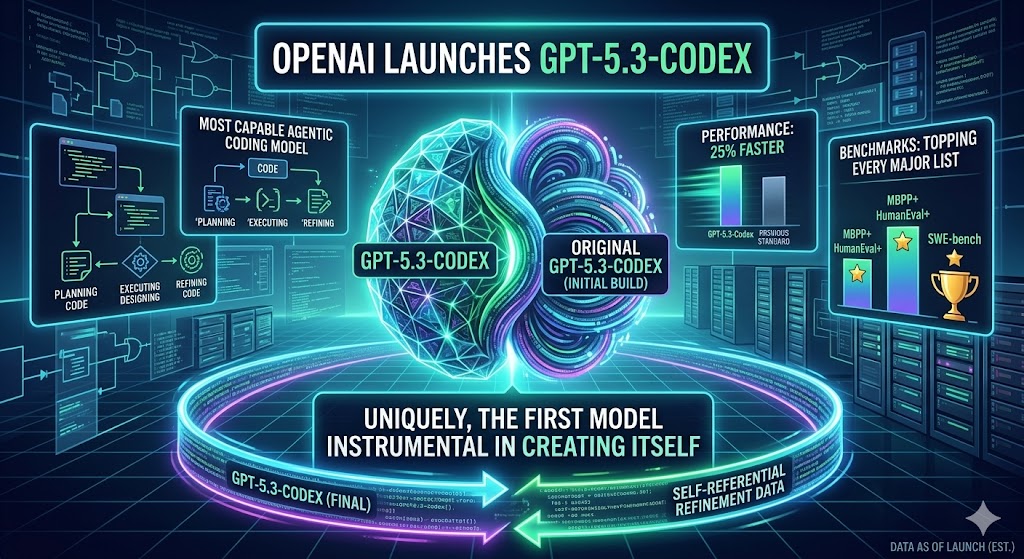
OpenAI has launched GPT-5.3-Codex, the most capable agentic coding model to date — 25% faster, topping every major benchmark, and uniquely, the first model that was instrumental in creating itself.
A Model That Helped Build Itself
OpenAI has introduced GPT-5.3-Codex, the most capable agentic coding model to date — and it comes with a detail that stops you mid-sentence: early versions of this model were used to debug its own training, manage its own deployment, and diagnose its own test results. The Codex team described being "blown away" by how much Codex was able to accelerate its own development. It's a milestone that raises profound questions about where this trajectory ends up.
What's Actually New
GPT-5.3-Codex is not just an incremental update. It combines two things that were previously separate:
- The frontier coding performance of GPT-5.2-Codex
- The reasoning and professional knowledge capabilities of GPT-5.2
The result is a single model that is also 25% faster than its predecessor — a combination of more capable and more efficient that doesn't often happen together. It enables the model to take on long-running tasks that involve research, tool use, and complex multi-step execution across days, not just minutes.
Benchmark Leadership Across the Board
GPT-5.3-Codex sets a new industry high on four key benchmarks:
- SWE-Bench Pro — a rigorous evaluation spanning four programming languages (not just Python), designed to be contamination-resistant and closer to real-world software engineering
- Terminal-Bench 2.0 — measuring terminal skills a coding agent needs, which GPT-5.3-Codex exceeds by a significant margin, using fewer tokens than any prior model
- OSWorld — computer use in real operating system environments
- GDPval — professional knowledge work across 44 occupations
The token efficiency point deserves emphasis: doing more with fewer tokens means lower cost and higher practical throughput for developers building on top of the model.
From Code Assistant to Full Computer Agent
The positioning here is deliberate. With GPT-5.3-Codex, Codex goes from an agent that can write and review code to an agent that can do nearly anything developers and professionals can do on a computer. That includes web development, documentation, data analysis, building games and applications from scratch over multi-day sessions, and professional knowledge work like presentations and spreadsheets.
Crucially, you can steer and interact with it while it's working, without losing context — much like a colleague you can check in on mid-task. That interactive quality is what separates it from batch-style code generation tools.
The Cybersecurity Caveat
This is where OpenAI's candor deserves credit. GPT-5.3-Codex is the first model OpenAI is treating as "High capability" under its Preparedness Framework for cybersecurity — meaning it can potentially automate end-to-end cyber operations against hardened targets, or discover and exploit operationally relevant vulnerabilities.
OpenAI is explicit that it cannot definitively confirm this crosses the threshold, but is taking a precautionary approach. The result: full API access is delayed, high-risk uses are gated behind safeguards, and a trusted-access program is in place for security professionals. It's the responsible path — but it also signals just how powerful this model has become.
Where It's Available
GPT-5.3-Codex launched on February 5, 2026, available to paid ChatGPT users across all Codex surfaces: the Codex app, CLI, IDE extensions (VS Code, JetBrains), and web. API access is coming soon. The timing — released within minutes of Anthropic's Claude Opus 4.6 launch — underscores the fierce race at the frontier of coding AI.
The Bigger Picture
What makes GPT-5.3-Codex significant isn't just the benchmark numbers. It's the fact that a model capable enough to assist in its own development has now shipped. The loop is closing: AI that improves AI, running in production, helping real teams ship real software. How fast that loop tightens from here is the most important open question in the industry right now.