The Next Evolution of OpenAI's Agents SDK: Standardizing the Autonomous Web
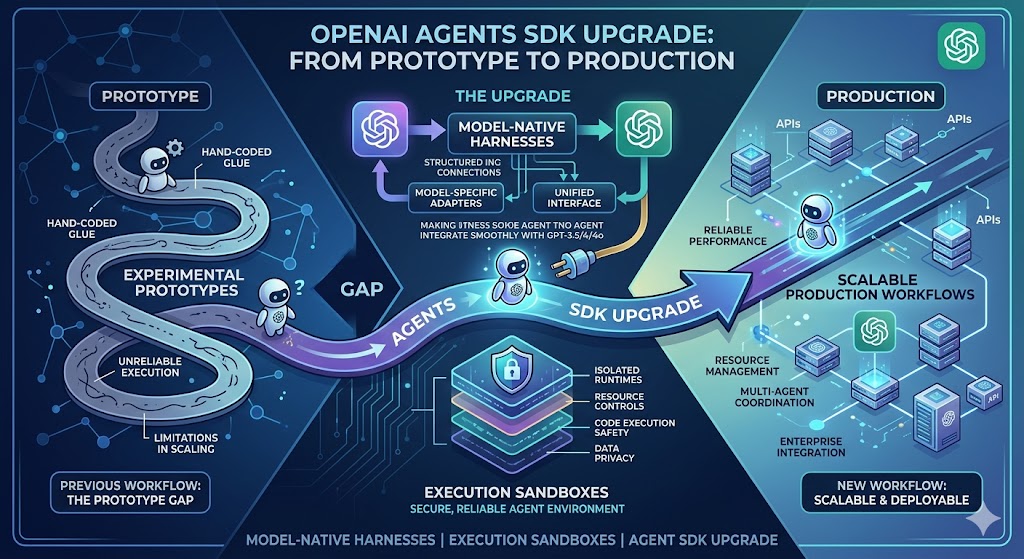
OpenAI has unveiled a major upgrade to its Agents SDK, introducing model-native harnesses and execution sandboxes to bridge the gap between AI agent prototypes and scalable production workflows.
Empowering the Agentic Loop
Building reliable AI agents requires more than just high-performing models; it demands a robust system architecture that can manage files, execute commands, and persist across multi-step workflows. OpenAI's latest update to the Agents SDK directly addresses these needs by introducing standardized infrastructure designed specifically for OpenAI models.
- Model-Native Harness: A new framework that allows agents to interact naturally with desktop tools and file systems, reducing the friction of custom integrations.
- Native Sandbox Execution: Agents can now run code and manage dependencies in a secure, isolated compute environment, ensuring data safety and predictable outcomes.
- Decoupled Architecture: By separating orchestration from compute, OpenAI enhances security, keeping credentials safe from model-generated code execution while allowing for high scalability.
- Persistence and Recovery: Features like snapshots and rehydration allow agents to resume complex tasks immediately after a failure, a critical requirement for production environments.
The Shift Toward Proactive Stance
This update signals OpenAI's transition from providing "conversational interfaces" to building "operational operating systems." By integrating industry-wide primitives like the Model Context Protocol (MCP) and AGENTS.md, OpenAI is not just releasing a tool—it is defining the standard language for how AI interacts with digital ecosystems. This security-first, action-oriented architecture effectively removes the last major barriers to enterprise-wide AI agent adoption, shifting the industry toward a future of autonomous, reliable digital workforces.
Source: OpenAI Agents SDK Evolution