OpenAI + Amazon Bedrock — The End of Stateless AI Agents
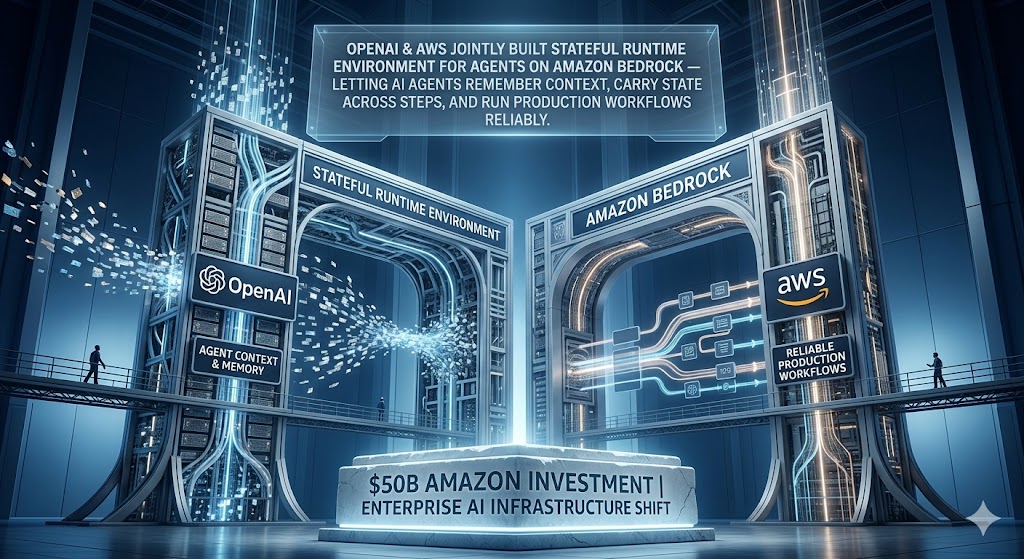
OpenAI and AWS have jointly built a Stateful Runtime Environment for agents on Amazon Bedrock — letting AI agents remember context, carry state across steps, and run production workflows reliably. Backed by a $50B Amazon investment, this is the infrastructure shift enterprise AI has been waiting for.
The Problem Every Enterprise AI Team Knows
Most AI agent prototypes work great in demos. Then production arrives. Suddenly you're wrestling with the same wall: the model forgets everything between steps. Developers have been stitching together external databases, custom memory layers, and brittle context management just to keep agents on track across multi-step workflows. It's expensive, fragile, and doesn't scale.
In late February 2026, OpenAI and Amazon Web Services announced a direct answer: a jointly developed Stateful Runtime Environment that runs natively inside Amazon Bedrock, designed to give AI agents persistent memory, tool context, identity, and governance — out of the box.
What "Stateful" Actually Means
Today, most developers interact with AI models through stateless APIs: every request starts fresh. You send a prompt, get a response, and the model retains nothing. For simple tasks, that's fine. For production enterprise work — support escalations spanning days, finance workflows requiring approvals, IT automation touching dozens of systems — stateless simply doesn't cut it.
A stateful runtime changes the equation. Instead of manually re-sending full context on every call, the runtime automatically carries forward:
- Memory and history — what the agent has done and learned across previous steps
- Tool and workflow state — which systems have been called, what outputs were returned
- Identity and permission boundaries — who the agent is acting on behalf of, and what it's allowed to do
- Environment context — compute, data access, and integrations the agent relies on
The result: agents that can run for days, pause and resume without losing their place, and operate across multiple tools and approvals in a single coherent workflow.
Built on Bedrock AgentCore
The Stateful Runtime Environment is built on top of Bedrock AgentCore — AWS's managed agent orchestration platform launched at re:Invent 2025. It integrates with OpenAI's Responses API and runs entirely within each customer's AWS environment, meaning data never leaves AWS infrastructure. Every agent action is logged for auditability, and IAM-scoped permissions ensure agents only do what they're explicitly authorized to do.
This isn't a bolt-on. The runtime is co-developed — trained to run optimally on AWS infrastructure and wired directly into the governance, security, and billing layers that enterprise AWS customers already use. Customers can deploy an OpenAI-powered agent inside their own AWS account and bill through a single unified Bedrock invoice.
The Deal Behind the Deal
The technical announcement sits on top of one of the largest AI infrastructure agreements ever signed. Amazon committed up to $50 billion in OpenAI — $15 billion initially with $35 billion more contingent on conditions — and OpenAI expanded its existing AWS commitment by $100 billion over 8 years, including consuming 2 gigawatts of Trainium capacity.
Strategically, the timing was deliberate. Microsoft's exclusive right to host and resell OpenAI's models expired on April 27, 2026. AWS launched OpenAI on Bedrock the very next day. The message was unmistakable: enterprises no longer have to route through Azure to access OpenAI's frontier models. GPT-5.5, GPT-5.4, and Codex are now available on Bedrock under standard AWS billing and IAM.
What This Unlocks for Enterprises
The use cases that previously required heroic engineering effort now become straightforward infrastructure decisions:
- Multi-system customer support — agents that remember full case history across sessions
- Sales operations workflows — automated pipelines spanning CRM, email, and approval chains
- Internal IT automation — long-running tasks that span tickets, provisioning, and verification
- Finance processes with approvals — workflows that pause for human sign-off and resume automatically
As Andy Jassy, Amazon's CEO, put it: "Being able to access state — whether it's memory or identity, or being able to call tools or call out to compute — in a stateful way, there's nothing else like that today."
The Bigger Power Shift
This announcement quietly reshapes the competitive landscape of enterprise AI infrastructure. For years, Azure held a structural advantage: if you wanted OpenAI's frontier models in production, you essentially had to be an Azure customer. That advantage is now gone. AWS enters the conversation as an equally credible, deeply integrated option — with native IAM, Bedrock's existing model ecosystem, and now the only stateful agent runtime co-developed with OpenAI itself.
For enterprise teams that have already standardized on AWS, this removes the last meaningful friction point in building production AI agents at scale. The demo-to-production gap — the graveyard of most enterprise AI initiatives — just got significantly narrower.