OpenAI Unveils Symphony: Open-Sourcing the Orchestration of Coding Agents
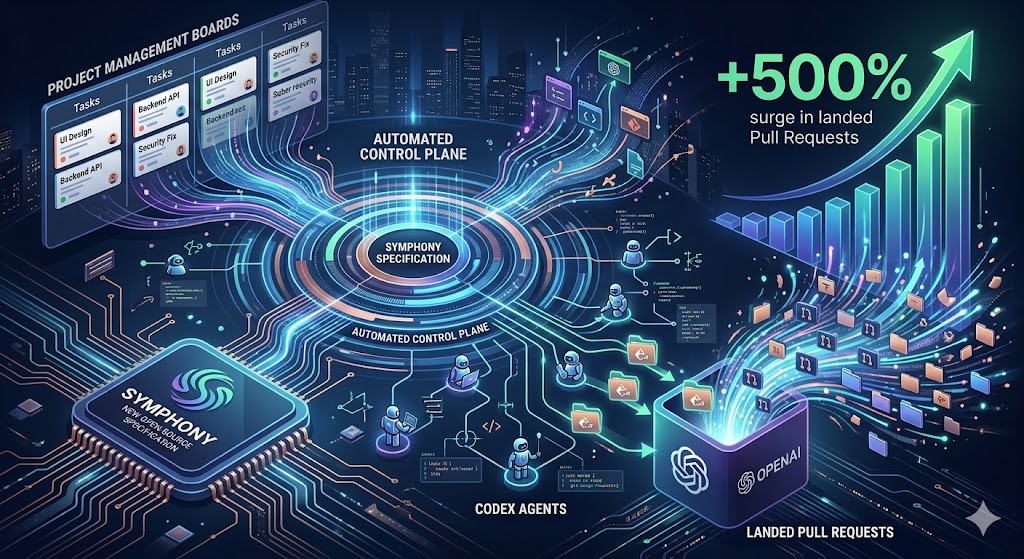
Symphony is a new open-source specification that transforms project management boards into automated control planes for Codex agents, driving a 500% surge in landed pull requests at OpenAI.
The Bottleneck of Human Attention
In the transition toward agent-first engineering, OpenAI identified a critical scaling barrier: not the capability of the agents, but the cognitive load on the engineers supervising them. Managing multiple parallel Codex sessions across CLI windows and browser tabs creates a human-centered bottleneck. To solve this, OpenAI released Symphony—an open-source specification (Apache 2.0) designed to decouple work from individual sessions and manual prompting.
How Symphony Orchestrates Work
Symphony acts as an orchestration layer that connects Codex agents directly to issue trackers like Linear. The system operates as a continuous state machine:
- Continuous Polling: Symphony monitors task boards for new assignments or status changes.
- Dedicated Workspaces: Each task is assigned an independent agent workspace where Codex can run tests, browse code, and monitor CI pipelines around the clock.
- Automatic Maintenance: The system automatically restarts agents that stall and prepares full pull requests for human review once a task is complete.
The results reported by internal OpenAI teams are stark: a 500% increase in landed pull requests within the first three weeks of deployment. This efficiency allows engineers to shift from "babysitting" individual agents to managing the high-level roadmap of the work itself.
The shift toward proactive orchestration
This move highlights a fundamental change in OpenAI's strategy. By open-sourcing Symphony as a reference implementation (written in Elixir/BEAM), OpenAI is not just providing a tool, but establishing a standard for "Harness Engineering." They are signaling that the future of software development lies in creating stable, predictable environments where AI agents can operate autonomously. This proactive leadership effectively commoditizes the orchestration layer, forcing the industry to focus on higher-level system design rather than simple prompt engineering.