GPT-5.3 Instant — The ChatGPT Update That Fixed the Cringe
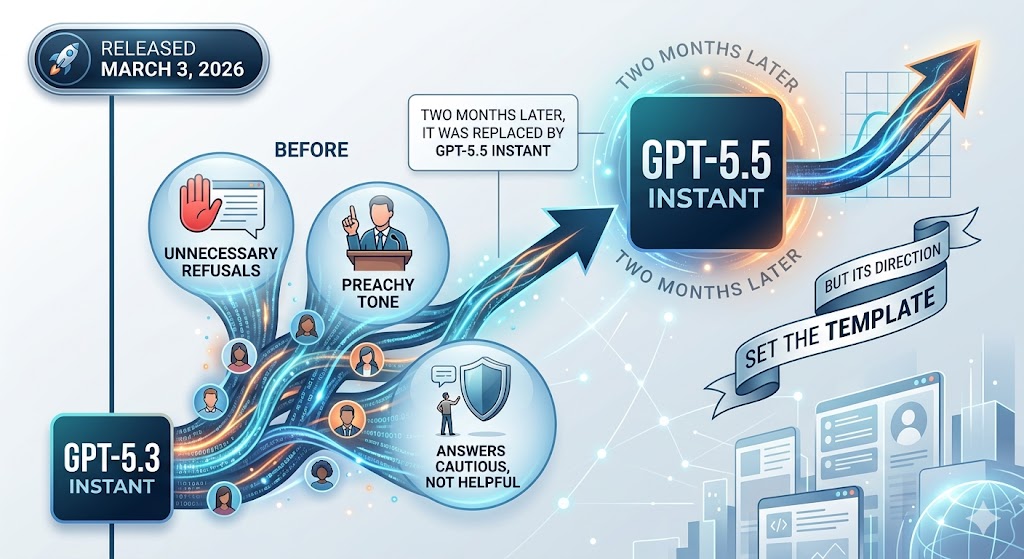
Released on March 3, 2026, GPT-5.3 Instant tackled the most human complaint about ChatGPT: unnecessary refusals, preachy tone, and answers that felt more cautious than helpful. Two months later it was replaced by GPT-5.5 Instant — but its direction set the template.
The Problem It Was Solving
Released on March 3, 2026, GPT-5.3 Instant was not a capability leap — it was a behavioral correction. OpenAI had been hearing the same feedback for months: ChatGPT was over-cautious, preachy, and prone to refusing questions it should have been able to answer safely. GPT-5.3 Instant was the direct, public acknowledgment that this needed to change.
The release notes were unusually candid: GPT-5.3 Instant significantly reduces unnecessary refusals, while toning down overly defensive or moralizing preambles before answering. When a useful answer is appropriate, the model now provides one directly — staying focused on the question without unnecessary caveats.
What Actually Changed
Three core improvements defined GPT-5.3 Instant:
- Fewer dead ends: Reduced unnecessary refusals on questions that are safe to answer, with less defensive throat-clearing before getting to the point.
- Smarter web search: Less likely to over-index on search results, which previously could produce long lists of links or loosely connected information. The model now surfaces the most important information upfront.
- Better conversational flow: Improved tone and follow-up quality, with a specific patch later in March that also reduced teaser-style phrasing — the kind of responses that say "If you want to know more..." instead of just answering.
None of these show up cleanly in benchmarks. But they shape whether ChatGPT feels helpful or frustrating in the everyday moments that matter most to most users.
The Refusal Problem, Addressed Openly
What made the GPT-5.3 Instant release notable was not just what changed — it was how openly OpenAI admitted the problem. The company acknowledged that GPT-5.2 Instant would sometimes refuse questions it should be able to answer safely, or respond in ways that feel overly cautious or preachy, particularly around sensitive topics.
For an AI company that had spent years being criticised for over-restriction, this was a meaningful shift in posture — from defending the caution to treating it as a bug worth fixing. The direction it set is arguably more significant than the specific improvements: OpenAI was now publicly committed to erring on the side of helpfulness.
Already Superseded — But the Direction Holds
GPT-5.3 Instant served as ChatGPT's default model for exactly two months before being replaced by GPT-5.5 Instant on May 5, 2026. The upgrade was substantial: 52.5% fewer hallucinated claims on high-stakes prompts in medicine, law, and finance, and a jump from 65.4 to 81.2 on the AIME 2025 math benchmark.
But GPT-5.5 Instant did not reverse GPT-5.3's direction — it extended it. The new model kept the reduced caveats and tighter tone, and pushed further toward conciseness, reducing verbosity by 30% and cutting back on what OpenAI called "gratuitous emojis." The behavioral philosophy that GPT-5.3 Instant introduced became the template for what ChatGPT is evolving into.
The Bigger Pattern
GPT-5.3 Instant was part of a clear cadence: a new Instant default roughly every two months, each one iterating on tone and quality rather than making headline-grabbing capability jumps. OpenAI is treating the everyday conversational experience as a product surface worth continuous, deliberate refinement — not just a byproduct of model scaling.
For most ChatGPT users who never touch the model picker, these quiet updates are the actual product. GPT-5.3 Instant was the moment OpenAI started taking that more seriously.