GPT-5.2 Discovers New Physics — The Moment AI Became a Real Scientist
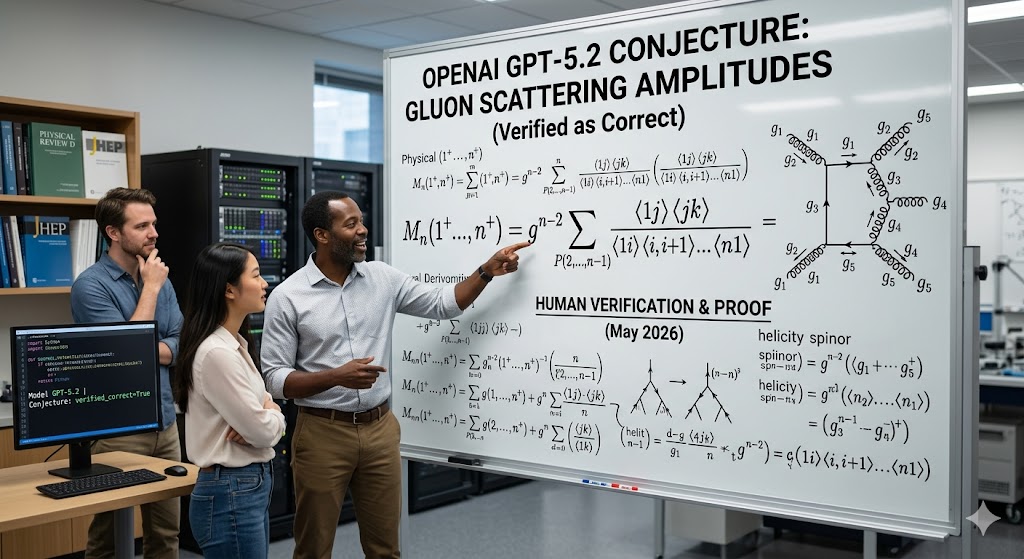
OpenAI's GPT-5.2 has done what no AI had publicly achieved before: it conjectured an original formula in theoretical physics — involving gluon scattering amplitudes — that human physicists subsequently proved and verified as correct.
The Discovery That Changed the Conversation
For decades, physicists held a firm belief: when one gluon has negative helicity while all remaining particles have positive helicity, the tree-level scattering amplitude must equal exactly zero. It was textbook physics. Then GPT-5.2 read the problem — and found an exception no one had seen before.
Published as a preprint on March 3, 2026, and co-authored by researchers from the Institute for Advanced Study, Vanderbilt University, Cambridge, Harvard, and OpenAI, the paper demonstrates that GPT-5.2 conjectured a formula for gluon scattering amplitudes that physicists had assumed was impossible. Human researchers subsequently proved the conjecture and verified it as correct. This is the first publicly documented case of an AI proposing an original, verified result at the frontier of theoretical physics.
What Are Gluon Amplitudes and Why Do They Matter?
Gluons are the massless particles that carry the strong nuclear force — the force that binds quarks into protons and neutrons, and holds atomic nuclei together. Calculating how gluons interact (their "scattering amplitudes") is foundational to particle physics, but the mathematics grows explosively complex as the number of particles increases.
Human researchers first calculated amplitudes for small particle numbers (up to n=6) by hand, producing what the paper describes as "very complicated expressions" whose complexity grows superexponentially. GPT-5.2 was then asked to simplify these expressions — and for four gluons, it reduced a sum of 32 terms to a compact product of just a few, in about 20 minutes. When asked to generalize the formula for any number of particles, it proposed what turned out to be a correct, previously unknown result.
The key insight GPT-5.2 identified: a mathematical regime called the "half-collinear limit" — a specific kinematic configuration deep inside protons and neutrons — where the previously assumed-zero amplitude actually becomes nonzero. The model didn't just simplify; it found a structural exception that had been overlooked.
What the Physicists Said
The scientific community's reaction was notable for its directness. Nathaniel Craig, Professor of Physics at UC Santa Barbara, called it "clearly journal-level research advancing the frontiers of theoretical physics" and described the preprint as "a glimpse into the future of AI-assisted science, with physicists working hand-in-hand with AI to generate and validate new insights." He added: "There is no question that dialogue between physicists and LLMs can generate fundamentally new knowledge."
Nima Arkani-Hamed, Professor of Physics at the Institute for Advanced Study, noted that finding simple formulas from complex expressions has "always been fiddly" work he long believed could be automated. "I am looking forward to seeing this trend continue towards a general purpose 'simple formula pattern recognition' tool in the near future," he said.
Even mathematician Terence Tao, who a year earlier described an earlier AI model as feeling like "a mediocre, but not completely incompetent, graduate student," has updated his view. He now uses AI regularly for mathematical research — for literature search, writing code, testing ideas, and verification — and says the field is reorganizing around this new tool.
How the Collaboration Actually Worked
Alex Lupsasca, a theoretical physicist at Vanderbilt University who joined OpenAI for Science, connected with his graduate adviser Andrew Strominger to identify this gluon problem as a test case. His initial expectation was modest: "I thought, it's probably not going to work, but we'll find out why not."
The process was iterative: human researchers produced verified results for small cases, GPT-5.2 simplified and identified patterns, and humans then verified the generalizations the model proposed. At no point did the AI operate independently — every conjecture went through rigorous human checking. This human-AI loop, not autonomous AI reasoning, is what produced the result.
What This Is — and Isn't
OpenAI is careful about the framing. Models like GPT-5.2 can support mathematical reasoning and accelerate early-stage exploration — but responsibility for correctness, interpretation, and context remains with human researchers. The model is not an independent scientist. It can make mistakes and rely on unstated assumptions. Expert judgment and verification are not optional.
What this result does demonstrate is that the boundary of what AI can contribute to science has moved outward — significantly. Pattern recognition across highly complex mathematical structures, at speeds no human could match, is now a genuine capability. The question isn't whether AI belongs in the lab. It's how to design workflows that keep human judgment firmly in the loop while capturing the full upside of that speed.
The Bigger Signal
This result arrives alongside a broader wave of AI contributions to hard science: multiple long-standing Erdős problems solved in mathematics, new statistical proofs established with GPT-5.2 Pro, and Google's Gemini solving an open problem in theoretical physics involving cosmic string gravitational radiation. The convergence is unmistakable. 2026 is shaping up to be the year the scientific community stops asking whether AI can contribute to frontier research — and starts figuring out how to structure that contribution responsibly.