OpenAI Introduces B2B Signals: The Compounding Advantage of Deep AI Adoption
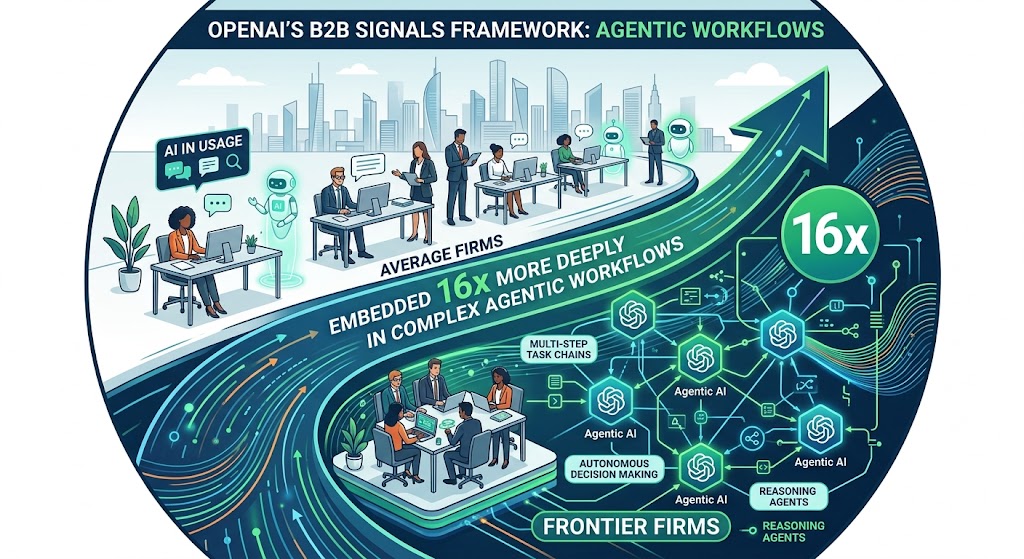
OpenAI's new B2B Signals framework reveals that frontier firms are pulling ahead not just by using AI more often, but by embedding it 16x more deeply into complex agentic workflows.
Understanding the "Frontier" Advantage
Today, OpenAI is introducing B2B Signals, an extension of OpenAI Signals that tracks how AI is truly diffusing across organizations. The data is clear: "Frontier Firms"—those in the 95th percentile of AI usage—are not just adopting AI; they are compounding their advantage through depth of use. These leaders now use 3.5x more intelligence per worker than typical firms, up from 2x just a year ago.
Beyond Message Volume: The "Depth" Gap
A critical finding from B2B Signals is that raw message volume only explains 36% of the gap between leaders and followers. The real differentiator is what the AI is being asked to do. Frontier firms are shifting from simple chat assistance to complex, multi-step agentic workflows. Nowhere is this more visible than in technical roles, where frontier firms use Codex (OpenAI's coding tool) at a staggering 16x higher rate than average organizations.
While general-purpose tools like data analysis and search show smaller adoption gaps, the "Frontier Gap" is widest in tools that support delegation—such as custom GPTs, Deep Research, and agentic integrations. These tools require higher organizational expertise and a greater comfort level with delegating work to autonomous systems.
The Shift Toward a Proactive Stance
To close this compounding gap, organizations must move beyond simply providing "seat access" and adopt a more strategic infrastructure for AI. The B2B Signals report identifies five essential practices:
- Measure Depth, Not Just Reach: Track whether AI is becoming more complex and integrated into valuable workflows over time, rather than just monitoring login counts.
- Build Agentic Governance: Leading firms don't avoid governance; they use it as an enabler. Clear rules for where agents can operate allow for safer, faster scaling of autonomous work.
- Continuous Enablement as Infrastructure: Treat AI training not as a one-time push, but as core infrastructure—utilizing internal champion networks and shared repositories of best practices.
- Scale Frontier Teams: Identify high-performing teams within the organization and replicate their habits across the firm.
- The Leap to Delegation: Encourage a shift from using AI as a static assistant to delegating entire tasks, allowing AI to work across codebases and tools autonomously.
Source: OpenAI B2B Signals