GPT-5.3 Instant — The Update That Fixes How ChatGPT Actually Feels
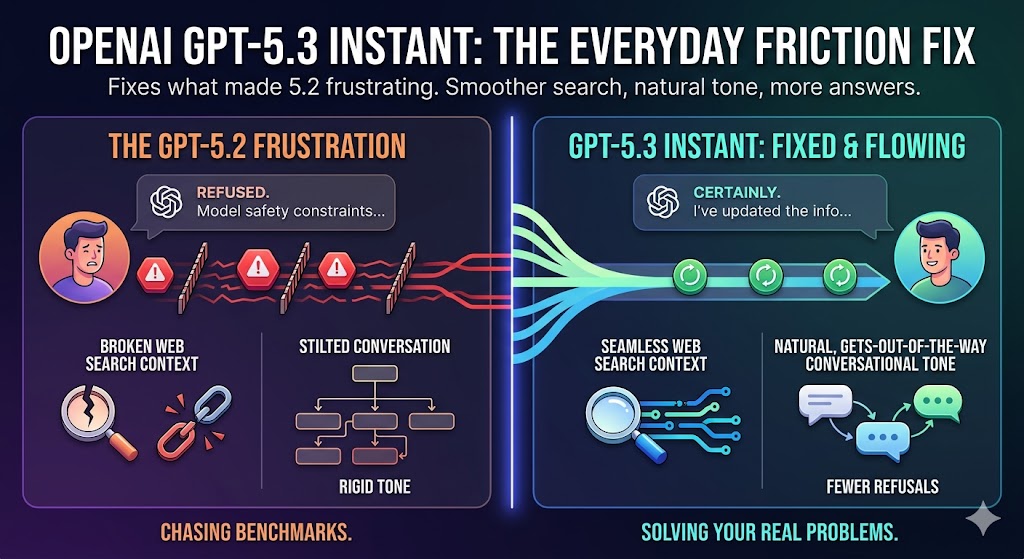
OpenAI's GPT-5.3 Instant doesn't chase benchmark headlines — it fixes the everyday friction that made GPT-5.2 frustrating: fewer refusals, better web search context, and a conversational tone that finally gets out of the way.
The Update Nobody Was Waiting For — Until They Used It
Most model updates come with benchmark tables and capability claims. GPT-5.3 Instant arrived with something rarer: an honest admission that the previous model was sometimes annoying to use. OpenAI described GPT-5.2 Instant as prone to unnecessary refusals, overly cautious phrasing, and moralizing preambles that interrupted the flow of conversation. GPT-5.3 Instant is a direct response to that feedback — and it shows.
This isn't a frontier capability leap. It's a quality-of-life update that targets something benchmarks don't measure well: whether ChatGPT actually feels helpful in the moment.
Fewer Dead Ends, Less Lecturing
The most tangible change is in how the model handles sensitive or borderline questions. GPT-5.3 Instant significantly reduces unnecessary refusals — the kind where a perfectly reasonable question gets met with a wall of caveats or an outright refusal that leaves users frustrated and no safer.
OpenAI's own example is instructive. When asked for help with trajectory calculations for long-distance archery, GPT-5.3 Instant now draws a clear line between legitimate physics education and operational weapon guidance — and answers the former directly, without a defensive preamble. The model still declines what it should decline. It just no longer declines what it shouldn't.
The overly defensive or moralizing tone that crept into GPT-5.2 Instant has also been dialed back. When a useful answer is appropriate, the model now provides it directly — staying focused on the question without unnecessary caveats upfront.
Smarter Web Search, Better Synthesis
Search integration has also been meaningfully improved. GPT-5.3 Instant is less likely to overindex on web results in ways that previously produced long lists of links or loosely connected information that felt more like a search engine dump than an actual answer.
The model now does a stronger job of recognizing the subtext of questions — understanding what someone is actually trying to learn, not just what keywords they typed — and surfacing the most important information upfront. The result is answers that are more relevant and immediately usable, without sacrificing speed or tone.
What's in the System Card
The safety profile of GPT-5.3 Instant closely follows GPT-5.2 Instant. OpenAI treats the model with the same mitigation approach across its key safety dimensions. A few notable points from the system card:
- Reduced refusal rates on sensitive topics without compromising on genuinely harmful requests
- Consistent safety posture inherited from GPT-5.2, with targeted improvements to reduce over-refusal
- Legacy transition: GPT-5.2 Instant will remain available for paid users for three months under Legacy Models, retiring on June 3, 2026
Where It Sits in the GPT-5 Family
GPT-5.3 Instant is the everyday workhorse model — the one most ChatGPT users interact with by default. It sits alongside GPT-5.3-Codex (the agentic coding specialist) in the broader GPT-5.3 generation. There's no GPT-5.4 Instant; the next step in the Instant line is GPT-5.5 Instant, which has since been released with even deeper context management and memory capabilities.
But at the time of its release, GPT-5.3 Instant was exactly what it needed to be: a model that stopped getting in the way of its own usefulness.
The Bigger Signal
This update reflects something important about where OpenAI's product thinking is heading. The era of "impressive but annoying" AI is over. Users have grown sophisticated enough to notice — and resent — when a model hedges unnecessarily, refuses reflexively, or wraps simple answers in layers of defensive language. GPT-5.3 Instant is OpenAI's acknowledgment that trust is built not just through capability, but through reliability of tone, consistency of helpfulness, and the simple discipline of answering the question that was asked.