OpenAI's Business Model: When Intelligence Itself Becomes the Product
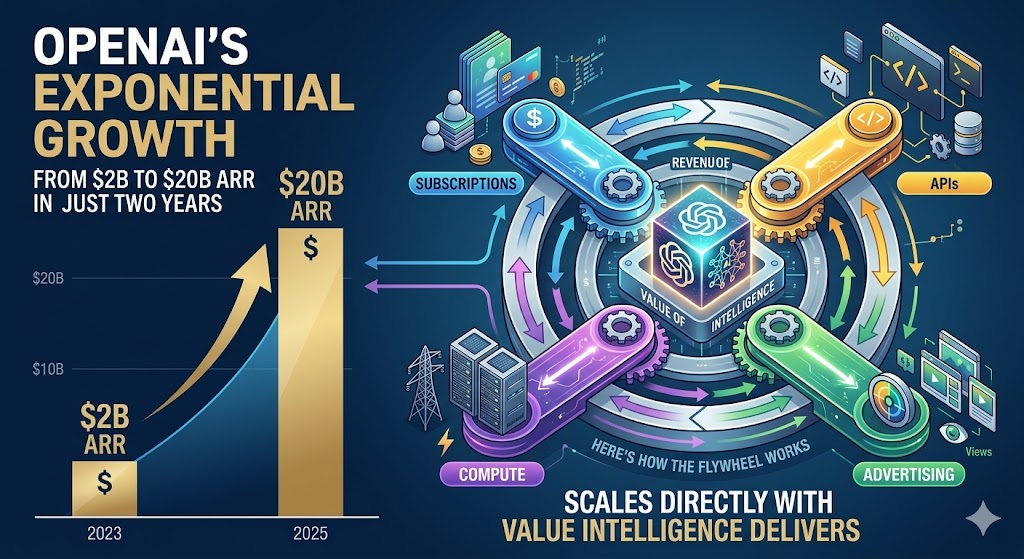
From $2B to $20B ARR in just two years, OpenAI has built a business model that scales directly with the value intelligence delivers — through subscriptions, APIs, advertising, and compute. Here's how the flywheel works.
A Business Principle That Actually Held
When OpenAI launched ChatGPT as a research preview, no one predicted what followed. Students started using it at midnight to untangle homework. Parents used it to plan trips and manage budgets. Writers used it to break through blank pages. Then people brought that leverage to work — a draft refined before a meeting, a spreadsheet checked one more time. What began as curiosity became infrastructure.
From that pattern, OpenAI drew a single guiding principle: the business model should scale with the value intelligence delivers. Three years on, the numbers suggest that principle has held.
The Growth Curve That Has No Precedent
The revenue trajectory is, by any measure, unlike anything the tech industry has seen before. OpenAI grew from $2B ARR in 2023 to $6B in 2024 to over $20B in 2025 — a 10x increase in two years. By March 2026, that figure had climbed past $25B, with the company generating $2 billion in revenue every single month.
What makes this more striking is that compute — not just product — drove it. Compute grew at the same rate: 0.2 GW in 2023, 0.6 GW in 2024, and approximately 1.9 GW in 2025. OpenAI has said plainly that more compute in those earlier periods would have led to faster adoption and monetization. Intelligence and infrastructure are not separable.
How the Revenue Model Is Actually Structured
OpenAI monetizes across four distinct layers, each designed to capture value at a different point in the adoption curve:
- Consumer subscriptions: ChatGPT Go ($8/month), Plus ($20/month), and Pro ($200/month) — with over 50 million paying consumer subscribers as of early 2026.
- Enterprise and workplace: Team, Business, and Enterprise tiers with more than 9 million paying business users. Enterprise now represents over 40% of total revenue and is on track to reach parity with consumer by end of 2026.
- API platform: Usage-based pricing that scales with real work getting done — processing more than 15 billion tokens per minute as of March 2026.
- Advertising: The newest layer, already generating over $100M in annualized revenue within six weeks of launch. Ads appear only for free and Go tier users, keeping paid tiers ad-free.
The design is deliberate: each tier unlocks when the previous one saturates, and costs scale in direct proportion to outcomes delivered. It is a textbook example of value-based monetization — except at a scale no textbook has covered.
Compute: From Constraint to Strategic Advantage
Three years ago, OpenAI relied on a single compute provider. Today it operates across a diversified ecosystem of providers, giving it resilience and — critically — compute certainty. It trains frontier models on premium hardware when capability matters most, and serves high-volume workloads on lower-cost infrastructure when efficiency takes priority. The result: latency drops, throughput improves, and useful intelligence can be delivered at costs that continue to fall.
This shift turns compute from a fixed constraint into an actively managed portfolio — one that compounds across research, product, and revenue simultaneously.
The Flywheel in Plain Terms
Consumer adoption creates distribution into the workplace. Enterprise deployment drives API usage and custom workflows. Developer activity expands the platform. Compute investment makes every token smarter and cheaper. Revenue funds the next generation of models. And better models drive more adoption. OpenAI calls this a reinforcing flywheel — and the numbers suggest it is spinning faster than anyone outside the company expected.
The focus for 2026 is practical adoption: closing the gap between what AI now makes possible and how individuals, companies, and countries are actually using it — especially in health, science, and enterprise, where better intelligence translates most directly into better outcomes.
The Numbers Behind the Story
ChatGPT crossed 900 million weekly active users by March 2026, holds 78% of global AI chatbot market share by web traffic, and its total AI time spent is four times that of all other AI apps combined. A $122 billion funding round closed in March 2026 at an $852 billion valuation. The company is not yet profitable — cash burn is projected at $17B in 2026, with cash-flow positive not expected until 2030 — but the trajectory of both revenue and adoption has consistently outrun its own projections.
In a market defined by uncertainty, that consistency is itself the signal worth watching.