OpenAI for Healthcare — When the Hospital Gets an AI Upgrade
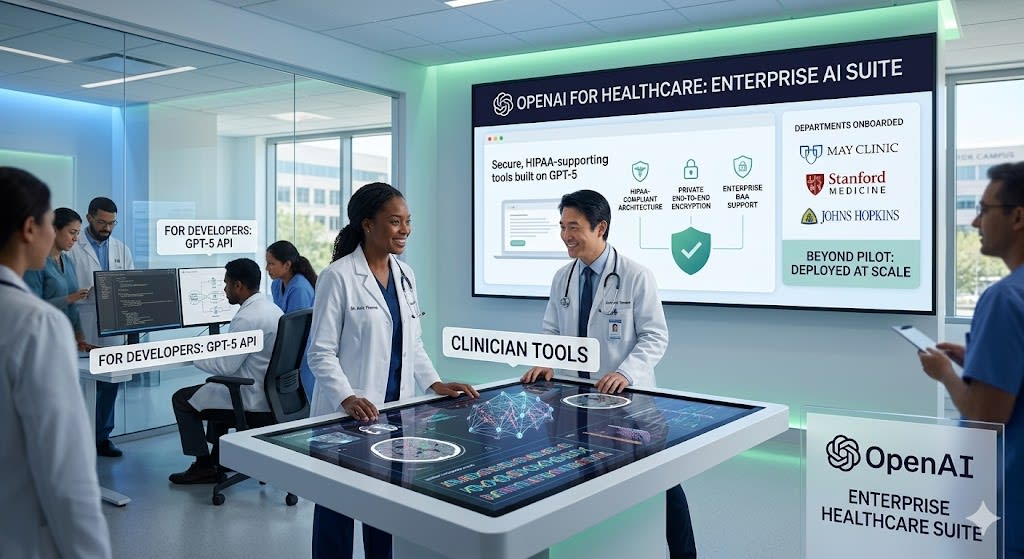
OpenAI has launched a full enterprise suite for healthcare — giving hospitals, clinicians, and developers secure, HIPAA-supporting AI tools built on GPT-5. The institutions already on board signal this is more than a pilot.
A Feature Born From Real Need
OpenAI has introduced OpenAI for Healthcare — a suite of secure AI products designed to help healthcare organizations deliver more consistent, high-quality care for patients, while supporting their HIPAA compliance requirements. If ChatGPT Health was built for patients, this one is built for the institutions behind them.
The Problem It's Solving
Healthcare is under unprecedented strain. Demand is rising, clinicians are overwhelmed by administrative work, and critical medical knowledge is fragmented across countless sources. The bottleneck isn't medical expertise — it's the sheer volume of repetitive, cognitive-heavy tasks that consume clinicians' time before they ever reach a patient. OpenAI is positioning itself squarely in that gap.
Two Products, Two Layers
ChatGPT for Healthcare is the enterprise workspace. It gives clinicians, administrators, and researchers access to AI tools within a centralized, secure environment — with role-based access controls, single sign-on, and governance features for organization-wide deployment. It is powered by GPT-5-based models developed specifically for healthcare workflows and evaluated through physician-led testing across benchmarks and real-world clinical scenarios.
The platform can retrieve and cite peer-reviewed research studies, public health guidance, and clinical guidelines, with responses including source details such as journal titles and publication dates. For clinicians who've learned to distrust AI outputs they can't verify, this citation layer is arguably the most important feature in the entire product.
OpenAI API for Healthcare is the developer-facing layer — allowing organizations to embed AI directly into their own healthcare systems and workflows, from patient chart summaries to care team coordination and discharge processes.
Who's Already Using It
Early adopters already rolling out ChatGPT for Healthcare include:
- AdventHealth
- Baylor Scott & White Health
- Boston Children's Hospital
- Cedars-Sinai Medical Center
- HCA Healthcare
- Memorial Sloan Kettering Cancer Center
- Stanford Medicine Children's Health
- University of California, San Francisco (UCSF)
That's not a test group — that's some of the most prestigious and operationally demanding institutions in American medicine. The signal is hard to ignore.
The HIPAA Answer
This is where OpenAI for Healthcare meaningfully separates itself from ChatGPT Health (the consumer product). Patient data and protected health information remain under each organization's control, with options for data residency, audit logs, customer-managed encryption keys, and a Business Associate Agreement (BAA) with OpenAI to support HIPAA-compliant use. Content shared with ChatGPT for Healthcare is not used to train models. For regulated environments, these aren't nice-to-haves — they're the price of entry.
The Bigger Picture
This launch builds on OpenAI's broader work across health, biopharma, and life sciences — including ChatGPT Health for consumers, research partnerships with Retro Biosciences, and collaborations with Moderna, BCG, Bain, McKinsey, and Accenture to help healthcare organizations accelerate AI adoption. The strategy is clear: own the full stack from individual patient to enterprise institution — and leave no gap for competitors to fill.