ChatGPT Now Teaches Math and Science With Live Interactive Visuals
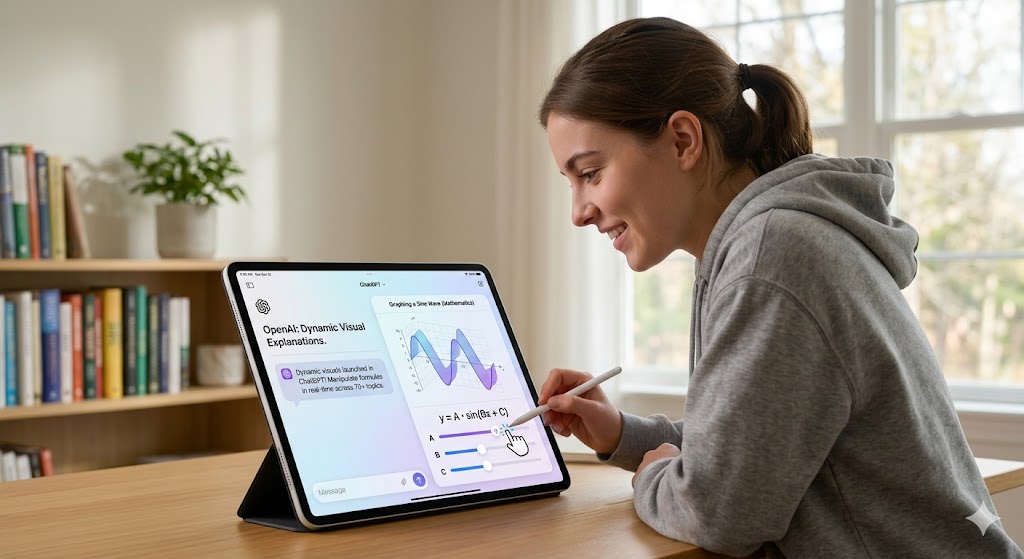
OpenAI has launched dynamic visual explanations in ChatGPT — letting users manipulate formulas and variables in real time across 70+ math and science topics. Available to all logged-in users globally, with no paywall or waitlist.
The Scale of the Problem
Each week, 140 million people use ChatGPT to help them understand math and science concepts alone. For many, these subjects have always felt abstract and inaccessible. In a recent Gallup survey, more than half of U.S. adults said they struggle with math, and many parents reported they don't feel confident helping their children learn it. Static text explanations and flat diagrams only go so far — and ChatGPT, until now, had the same limitation.
That changes with the launch of dynamic visual explanations: interactive modules that turn abstract formulas into something users can directly experiment with.
How It Works
When someone asks ChatGPT about a supported concept, the model responds with both a text explanation and an interactive visual module. Users can adjust variables, manipulate formulas, and instantly see how those changes affect graphs and outcomes in real time.
The mechanic is intuitive by design. Ask about the Pythagorean theorem and you can drag the sides of a triangle — the hypotenuse updates live. Ask about Charles' Law and you can change temperature or pressure and watch the other variables respond. The goal isn't to deliver an answer — it's to build intuition about why the answer works.
70+ Topics, Available Now
The feature launches with more than 70 core math and science concepts, including:
- Pythagorean theorem, binomial square, difference of squares
- Area of a circle, compound interest, exponential decay
- Charles' Law, Coulomb's Law, Hooke's Law, Ohm's Law
- Kinetic energy, linear equations, lens equations
The rollout is available to all logged-in ChatGPT users globally — across all subscription plans, with no paywall and no waitlist. Users don't need to enable anything. Ask about a supported topic and the module appears automatically.
Built on Top of Study Mode
This isn't a standalone feature — it's the next layer of a deliberate education strategy. OpenAI introduced Study Mode in July 2025, adding step-by-step guidance, Socratic-style prompts, quizzes, and skill-level calibration to ChatGPT. That was about pacing and scaffolding. The new interactive visual layer is about experimentation and intuition-building — two things that are fundamentally harder to achieve with text alone.
OpenAI flagged visual interactivity as a planned next step when Study Mode launched, making this a continuation rather than a pivot.
What Educators Are Saying
"What stands out is how strongly this feature emphasizes conceptual understanding," said Anjini Grover, a High School Mathematics Teacher. "When learning math, understanding why something works and how ideas connect helps concepts stick long term. I especially appreciate how it doesn't stop at the original question but actively prompts you to extend thinking and explore deeper connections."
The broader education community has debated AI's role in learning — with some worried about over-reliance. But the design of this feature pushes in a different direction: rather than just delivering answers, it asks users to engage with the underlying concepts directly.
What Comes Next
OpenAI has committed to expanding interactive learning to additional subjects over time, though no specific topics or timeline have been announced. The company also plans to publish findings from its Learning Lab research into how AI shapes learning outcomes — an area where the research landscape is still forming but early signals from Study Mode have been encouraging.
For 140 million weekly users already turning to ChatGPT for STEM help, this update doesn't change what the tool fundamentally is. It adds a better format for questions the model already handled — and for that specific use case, it's a clear step forward.
Source: openai.com — New ways to learn math and science in ChatGPT