The Five AI Value Models Driving Business Reinvention
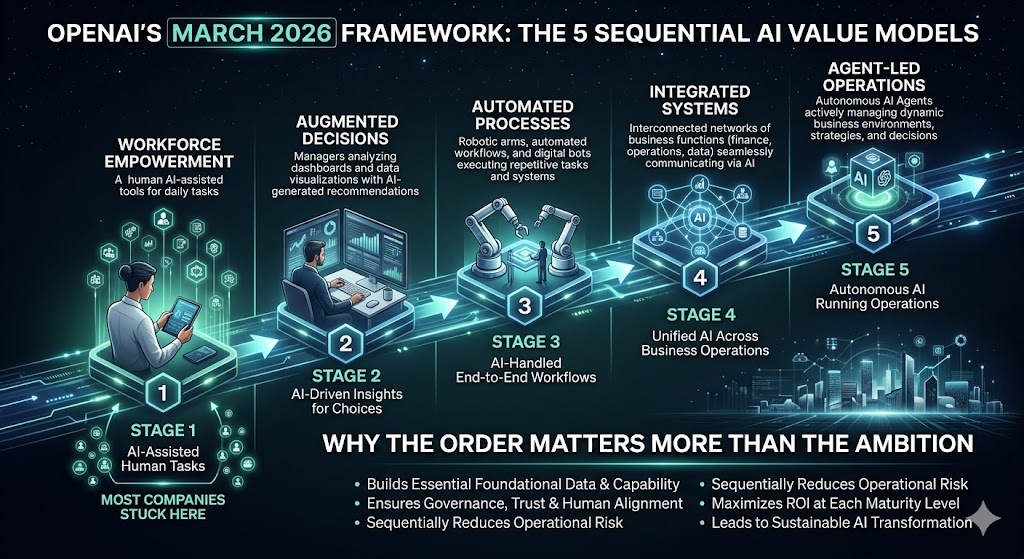
OpenAI's March 2026 framework lays out five sequential AI value models — from workforce empowerment to agent-led operations. Most companies are stuck at stage one. Here's why the order matters more than the ambition.
Why Most AI Pilots Go Nowhere
Most companies today treat AI as a collection of disconnected experiments — a pilot here, a use case there — and wonder why the results never add up to real transformation. OpenAI's March 2026 framework names this pattern directly: it's like building interactive banners while eCommerce was rewriting retail entirely. The tools are real, the effort is real, but the strategy is missing.
The framework introduces five distinct AI value models that must be built in sequence. Each creates value differently, operates on its own economics and timeline, and — crucially — builds the foundation that the next one requires. Skip a step, and automation creates risk faster than value.
The Five Models, In Order
1. Workforce Empowerment
This is where every organization must begin. Tools like ChatGPT spread AI fluency across HR, legal, finance, and operations — not just as faster drafting tools, but as the foundation for organizational consensus on what AI can and cannot do. Without this broad literacy, every subsequent model runs into resistance, misuse, or unrealistic expectations. The goal isn't speed. It's shared understanding.
2. AI-Native Distribution
Once the workforce is fluent, the focus turns outward: how customers discover and interact with products. Conversational interfaces are replacing traditional funnels, and in these channels, conversions happen in conversations. The critical warning from OpenAI: treat AI-native distribution like a volume play — optimizing for reach over relevance — and you destroy the trust that makes the channel work at all.
3. Expert Capability
This model targets the bottlenecks where specialized knowledge creates the most friction — research, creative production, complex analysis. Tools like Co-scientist and Sora compress expert bottlenecks by expanding the range of what teams can explore, test, and produce. Over time, teams shift from producing first drafts to directing and reviewing AI-generated outputs. The value isn't just efficiency — it's expanding the scope of what's possible to attempt.
4. Systems and Dependency Management
This is where AI moves beyond assistance into the infrastructure layer — updating codebases, SOPs, contracts, and policy documents in ways that remain safe, audited, and reversible. This model requires clean permissions, identity controls, and exception handling that earlier stages helped build. Without those foundations, this stage amplifies risk rather than managing it.
5. Agent-Led Process Re-engineering
The pinnacle of the framework: AI agents take full ownership of end-to-end workflows — procure-to-pay, insurance claims, supply chain management, clinical operations. This isn't assistance or automation. It's orchestration. OpenAI is explicit that this stage is the slowest to implement and the most transformative, and it depends entirely on the foundations built in all four prior models. An insurer using agents for claims processing, or a manufacturer running autonomous production chains, can only do so safely because governance, integration, and dependency management are already mature.
The Compounding Logic
The sequence isn't arbitrary. Workforce empowerment builds fluency. Fluency makes governance workable. Governance enables deeper system integration. Integration makes dependency management possible. Dependency management makes agent-led operations safe. Each layer unlocks the next — and organizations that skip steps typically end up with automation that creates liability rather than leverage.
OpenAI offers a three-phase playbook to navigate this: first, build fluency and trust through broad empowerment and basic governance; second, capture value with targeted high-ROI motions in distribution, expert capability, and critical workflows; third, scale AI into high-dependency systems and end-to-end workflows once controls are mature enough to support it.
The Uncomfortable Truth for Most Organizations
The framework matters most because it explains a pattern most leaders recognize but rarely name: organizations have pockets of Stage 1 scattered across departments, nothing systematic beyond that, and mounting pressure to jump straight to Stage 5. The result is pilots that impress in demos and fail in production.
The companies that will extract the most from AI won't be the ones running the most experiments. They'll be the ones that understand which value model to build next, what foundation it requires, and what it unlocks after that — and have the discipline to follow that sequence even when the temptation to skip ahead is real.
Source: OpenAI — The five AI value models driving business reinvention