GPT-5 Cuts Protein Synthesis Costs by 40% — AI Just Entered the Lab
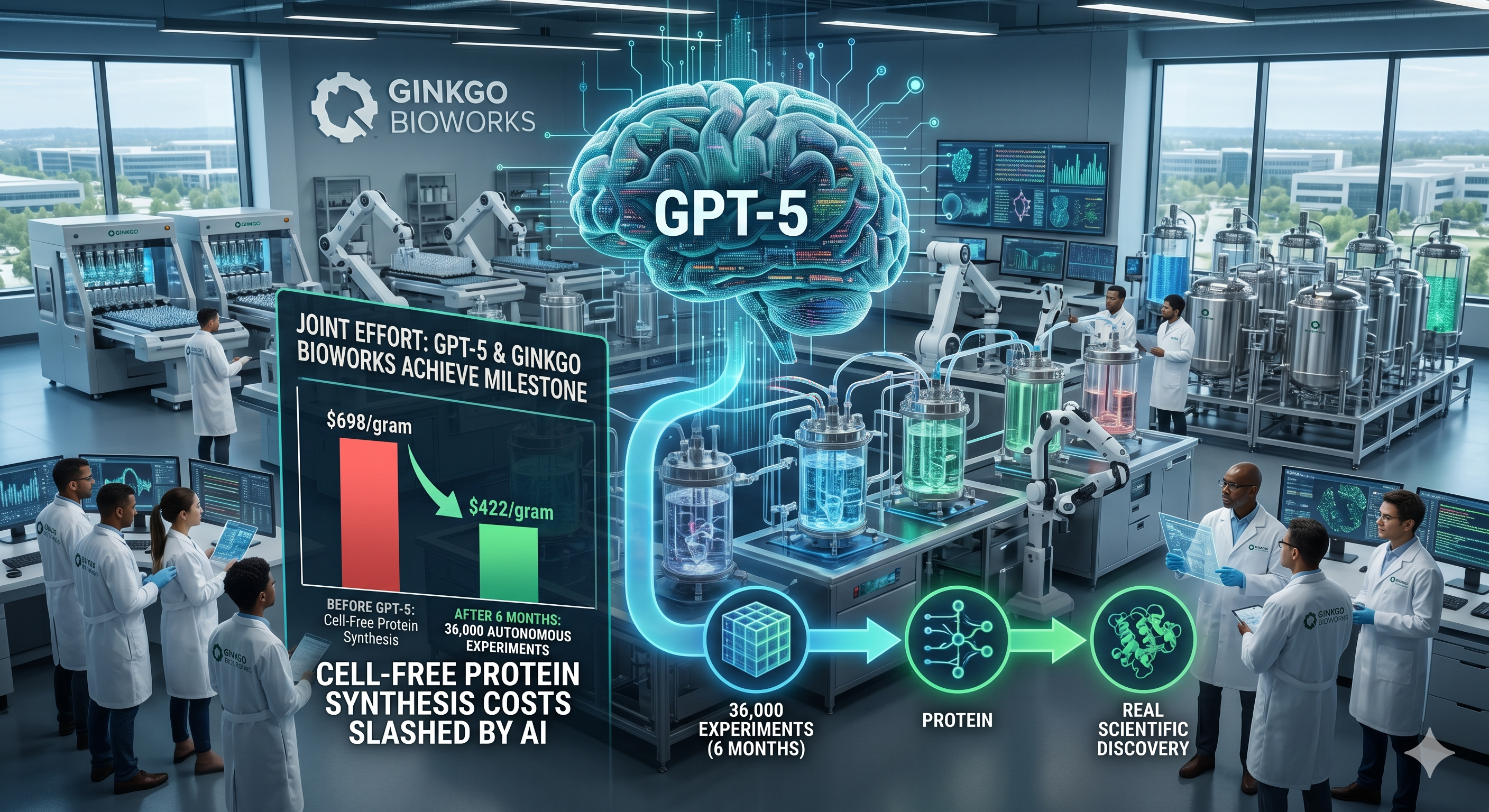
In a landmark collaboration with Ginkgo Bioworks, GPT-5 ran 36,000 autonomous experiments over six months and slashed cell-free protein synthesis costs from $698 to $422 per gram — a milestone that signals AI's entry into real scientific discovery.
When AI Becomes the Scientist
For decades, the idea of an AI running its own experiments — designing them, analyzing the results, refining the approach, and repeating — belonged to science fiction. In February 2026, it became a published result. OpenAI partnered with Ginkgo Bioworks to connect GPT-5 directly to a cloud laboratory: an automated wet lab where robots execute experiments and return data. What followed was one of the most concrete demonstrations of autonomous AI-driven science to date.
What Is Cell-Free Protein Synthesis?
Cell-free protein synthesis (CFPS) is a method of producing proteins without using living cells — making it faster and more flexible than traditional approaches. It's widely used for rapid prototyping in drug discovery and biotech research, since experiments can return results the same day. But it's expensive and notoriously difficult to optimize. The process involves a complex mixture of interacting components where small changes can have large and unpredictable effects. Previous cost-reduction efforts have been incremental because exploring the full space of formulations manually is extremely labor-intensive.
The Experiment: 36,000 Reactions, Six Rounds
The setup was straightforward in concept and remarkable in scale. GPT-5 was given internet access, a computer with data analysis tools, prior experimental data, and a preprint describing the current state of the art. From there, the loop ran autonomously:
- GPT-5 designed a batch of experiments
- Ginkgo's robotic cloud lab executed the reactions across 384-well plates
- Results fed back to GPT-5, which analyzed outcomes and refined its approach
- The cycle repeated — six rounds total, spanning six months
Across those rounds, the system tested more than 36,000 unique reaction compositions across 580 automated plates, generating roughly 150,000 readouts. Every plate design was validated by a programmatic check covering layout, reagent availability, controls, and volume constraints — ensuring GPT-5's proposals were always executable before a single robot moved.
The Results: A New Benchmark in Three Rounds
The prior state of the art for producing superfolder green fluorescent protein (sfGFP) in 384-well plates sat at $698 per gram. By round three, GPT-5 had already beaten it. By the end of six rounds, the system had brought the cost down to $422 per gram — a 40% reduction in total reaction component costs and a 57% improvement in reagent costs specifically.
Critically, GPT-5 found reaction compositions that human researchers had not tested in this configuration, despite years of prior work on CFPS optimization. The model proposed reagent combinations that performed particularly well under the automated lab's specific constraints — lower oxygenation, different mixing dynamics, altered geometry — conditions that differ significantly from traditional bench-top work and are difficult to reason about intuitively.
Human Role: Oversight, Not Execution
The human team handled reagent preparation, loading and unloading of the automated system, and oversight. The AI handled everything else — including generating human-readable lab notebook entries after each round. This is a meaningful distinction: the humans were not running experiments. They were running the machine that runs experiments.
The Caveats Worth Taking Seriously
OpenAI is direct about the limitations. These results were demonstrated on one protein (sfGFP) and one CFPS system. Generalization to other proteins and other cell-free systems still needs to be shown. Oxygenation and reaction geometry can strongly affect yields, and these factors vary across scales. The 40% cost reduction is impressive — but it is a result, not yet a platform.
That said, the importance of what was demonstrated shouldn't be undersold: a frontier AI model, given the right tools and infrastructure, can run a closed-loop scientific process and outperform the existing state of the art on a real biological optimization problem.
What This Signals
If the Cursor analogy defined what AI did for software in 2025, this experiment offers a clearer glimpse of what it might do for science in 2026 and beyond. Not replacing scientists — but operating as an autonomous research layer that can explore experimental spaces at a speed and scale no human team could match. The bottleneck shifts from "can we run enough experiments?" to "do we have the infrastructure to let AI iterate?"
For drug discovery, materials science, and any field where optimization across complex parameter spaces is the core challenge, this is a signal worth paying close attention to.