OpenAI Codex Security — The AI That Thinks Like a Hacker to Defend Like One
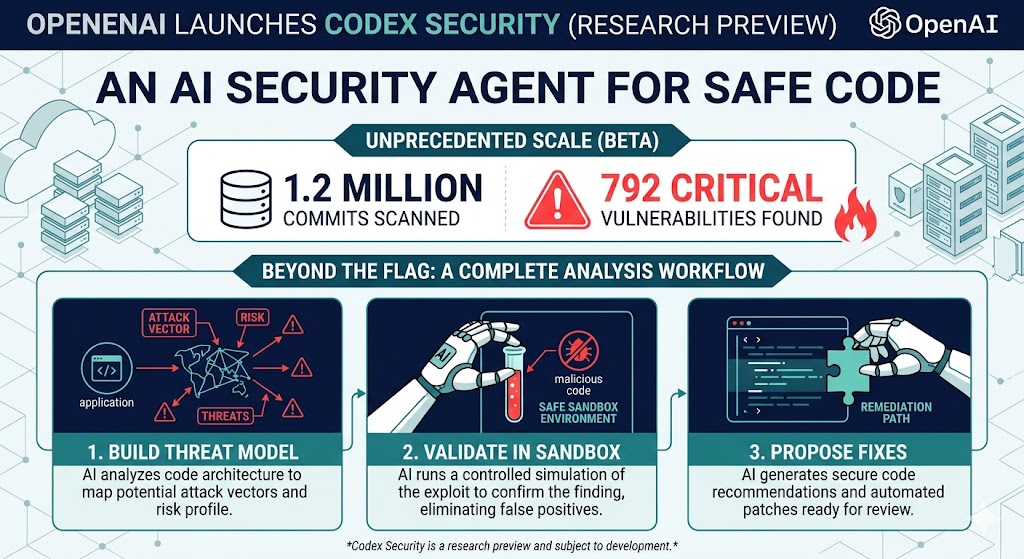
OpenAI has launched Codex Security in research preview — an AI security agent that scanned 1.2 million commits in beta and found 792 critical vulnerabilities. It doesn't just flag issues; it builds a threat model, validates findings in a sandbox, and proposes fixes.
From Aardvark to Codex Security
The story of Codex Security begins in October 2025, when OpenAI quietly launched a private beta called Aardvark — an agentic security researcher designed to detect and fix vulnerabilities at scale. After six months of refinement and real-world testing across external repositories, Aardvark has now evolved into Codex Security, integrated directly into the Codex platform and available as a research preview as of March 6, 2026.
The rebranding signals more than a name change — it signals intent. Security is no longer a standalone experiment at OpenAI. It is a first-class capability baked into the same platform developers already use every day.
What Codex Security Actually Does
Codex Security is designed to work more like a security researcher than a traditional scanner. Rather than pattern-matching against known vulnerability signatures, it reasons through code the way a human expert would:
- Builds a threat model — it analyzes repository structure, maps trust boundaries, and generates an editable threat model specific to your codebase
- Hunts for vulnerabilities — it searches for complex issues that simple scanners miss, including multi-step attack paths
- Validates in a sandbox — potential findings are tested in an isolated environment to rule out false positives before surfacing them
- Proposes fixes — it delivers actionable patches with plain-language explanations, ranked by severity and real-world impact
Crucially, once a threat model exists for a project, every subsequent Codex session inherits that security context. This isn't a one-time scan — it's persistent security infrastructure embedded in the development workflow.
The Beta Numbers Are Hard to Ignore
During its beta period, Codex Security scanned more than 1.2 million commits across external repositories and surfaced 792 critical findings and 10,561 high-severity findings. Critical issues appeared in under 0.1% of commits — a precision rate that matters enormously in a field where alert fatigue from false positives is a genuine crisis.
Among the real-world vulnerabilities discovered in major open-source projects:
- GnuTLS — heap buffer overflow, heap buffer overread, and double-free vulnerabilities
- GOGS — two-factor authentication bypass and unauthenticated access bypass
- Thorium — seven separate CVEs covering path traversal, LDAP injection, DoS vulnerabilities, and session management flaws
- OpenSSH, libssh, PHP, Chromium — additional high-impact findings across critical infrastructure software
These aren't theoretical vulnerabilities in toy codebases. They are security holes in software that millions of systems depend on daily.
The Ongoing Impact
Since the research preview launched, Codex Security has contributed to over 3,000 critical and high-severity fixed vulnerabilities across the ecosystem — a number that continues to grow as more teams connect their repositories. The compounding effect is significant: every vulnerability fixed is an attack surface permanently removed, not just flagged.
Who Gets Access and How
Codex Security is currently available to ChatGPT Pro, Enterprise, Business, and Edu customers via the Codex web interface, with the first month of usage free. It connects directly to GitHub repositories — after enabling a repository, the agent begins building its threat model and scanning history automatically.
The research preview framing is deliberate: OpenAI is gathering real-world feedback at scale before a broader rollout. But given the beta results, "preview" feels more like a formality than a caveat.
The Bigger Picture: Tipping the Balance
Each year, tens of thousands of new vulnerabilities are discovered across enterprise and open-source codebases. Security teams are perpetually outnumbered — defenders must find every flaw while attackers only need to find one. OpenAI has been explicit about its goal: to tip that asymmetry in favor of defenders.
Codex Security represents a credible step toward that goal. By combining the reasoning capabilities of frontier AI models with automated validation and workflow integration, it transforms security from a periodic audit into a continuous, intelligent process. The question is no longer whether AI can help with cybersecurity — the beta numbers already answered that. The question now is how fast organizations will move to make it part of how they build software.
Source: https://openai.com/vi-VN/index/codex-security-now-in-research-preview/