OpenAI Bets $7.5M on Independent AI Alignment — Because No One Can Do It Alone
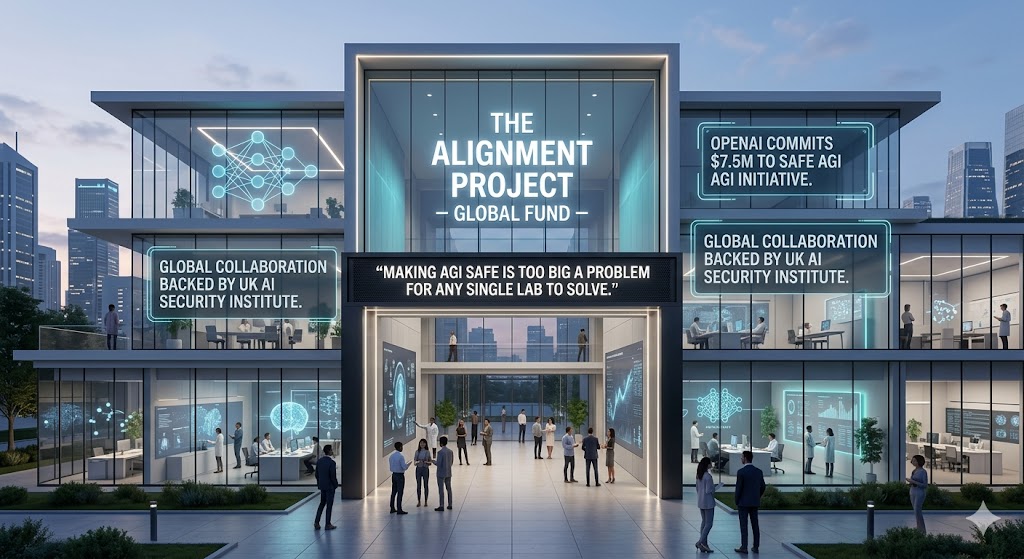
OpenAI has committed $7.5M to The Alignment Project, a global fund backed by the UK AI Security Institute. The move acknowledges a hard truth: making AGI safe is too big a problem for any single lab to solve.
The Admission Behind the Announcement
OpenAI has committed $7.5 million to The Alignment Project — a global fund for independent AI alignment research created by the UK AI Security Institute (UK AISI), with Renaissance Philanthropy administering the grant. The headline number matters less than what the announcement implies: one of the world's most capable AI labs is publicly acknowledging that solving alignment cannot be achieved by any single organization working alone.
That's not a PR move — it's a structural reality. As AI systems grow more capable and more autonomous, the diversity of approaches brought to bear on alignment research becomes as important as the depth of any single approach.
What The Alignment Project Actually Is
The Alignment Project is the largest dedicated funding pool for independent AI safety research in existence. OpenAI's $7.5M contribution (approximately £5.6 million) brings the total fund to over £27 million, co-funded by an international coalition including Microsoft, Amazon Web Services, Anthropic, Schmidt Sciences, the Canadian Institute for Advanced Research (CIFAR), the Australian AI Safety Institute, and multiple philanthropic organizations.
Individual grants range from £50,000 to £1 million, and recipients may also receive optional access to compute resources and expert mentorship from AISI's own research team. In its first round, the fund awarded grants to 60 projects across 8 countries, selected from over 800 applications submitted by 466 institutions across 42 countries — a scale of interest that underscores just how much latent alignment research capacity exists outside the major labs.
Why Independent Research Matters
OpenAI is clear about the logic: frontier labs like OpenAI are well-positioned to pursue alignment research that requires access to cutting-edge models and large-scale compute. But that very proximity to the frontier creates blind spots. Independent researchers can explore conceptual, theoretical, and unconventional ideas that may not fit neatly into any one organization's roadmap — and those ideas may turn out to matter most.
The portfolio of funded research reflects this breadth deliberately. Topics span computational complexity theory, economic and game theory, cognitive science, information theory, and cryptography. This isn't alignment research as a narrow technical discipline — it's alignment research as a wide-open intellectual problem that may require breakthroughs from unexpected directions.
A World-Class Advisory Board
The Alignment Project is guided by an expert advisory board that includes some of the most respected names in AI and computer science: Yoshua Bengio (Université de Montréal, Mila), Zico Kolter (Head of Machine Learning at Carnegie Mellon), Shafi Goldwasser (UC Berkeley, Simons Institute), and Andrea Lincoln (Boston University). The board's composition signals that this is not a peripheral initiative — it reflects where serious researchers believe the hardest problems lie.
The OpenAI Safety Fellowship: Going Further
Alongside its funding commitment, OpenAI has separately announced the OpenAI Safety Fellowship — a pilot program running from September 2026 through February 2027, inviting external researchers, engineers, and practitioners to pursue high-impact safety and alignment research with direct access to OpenAI's environment. Priority areas include safety evaluation, robustness, scalable mitigations, agentic oversight, and high-severity misuse domains. It's a signal that OpenAI sees talent development as part of the alignment equation, not just funding.
The Deeper Logic
Progress toward AGI may ultimately depend on fundamental breakthroughs that reshape the alignment problem entirely. If today's dominant methods don't scale the way the field expects, the research that will matter most is the kind being done independently — uncorrelated with any single lab's assumptions, free to challenge received wisdom, and structurally incentivized to find what everyone else might have missed.
OpenAI's $7.5M isn't just a grant. It's a hedge against the possibility that the answers to the most important problem in AI development won't come from inside any single organization — including OpenAI itself.