The OpenAI Foundation — How a $130B Nonprofit Is Betting on Humanity
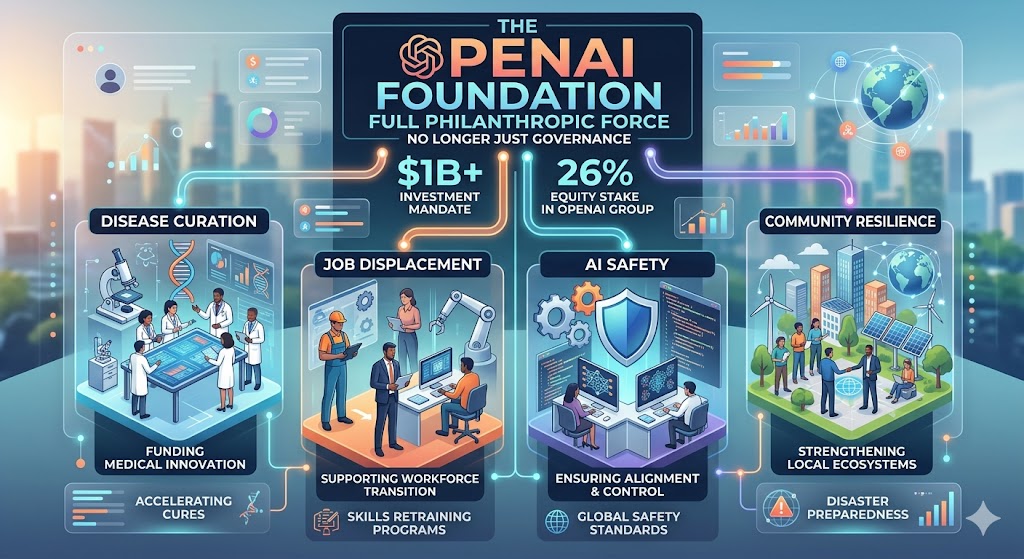
The OpenAI Foundation is no longer just a governance structure — it's a fully operational philanthropic force with a $1B+ investment mandate, a 26% equity stake in OpenAI Group, and programs spanning disease curation, job displacement, AI safety, and community resilience.
From Governance Structure to Philanthropic Force
When OpenAI restructured in October 2025 — converting its for-profit arm into a Public Benefit Corporation called OpenAI Group PBC — the nonprofit was renamed the OpenAI Foundation. What many observers treated as a legal formality has quietly become something much more significant: a fully operational philanthropic organization with serious capital, serious people, and a serious mandate.
The Foundation holds a 26% equity stake in OpenAI Group, worth approximately $130 billion at current valuations — making it the single largest long-term beneficiary of OpenAI's commercial success. More importantly, it retains the governance rights to appoint and remove all board members of OpenAI Group at any time. The mission isn't separate from the business; it controls it.
$1 Billion, Four Programs
Over the next year, the Foundation expects to invest at least $1 billion across four core areas:
- Life Sciences & Curing Diseases — leveraging AI to accelerate scientific and medical progress, move discoveries from lab to patient faster, and explore new approaches to prevention and treatment
- Jobs & Economic Impact — engaging economists, unions, civil society, and policymakers to develop practical solutions for communities navigating AI-driven workforce change
- AI Resilience — addressing new challenges from more capable AI systems, with a focus on preserving human agency, creativity, and opportunity
- Community Programs — continuing and expanding the People-First AI Fund, investing in organizations that help communities understand and benefit from AI
This includes early investments toward OpenAI's previously announced $25 billion commitment to curing diseases and building AI resilience — a target that makes the $1B first-year pledge feel less like an endpoint and more like a starting gun.
The Team Taking Shape
The Foundation is staffing up fast. Key appointments signal the seriousness of the operation:
- Wojciech Zaremba (OpenAI co-founder) joins as Head of AI Resilience — a significant signal that OpenAI's founding generation is personally invested in this work
- Jacob leads the People-First AI Fund, continuing community-based grant work
- Anna Makanju joins in mid-April as Head of AI for Civil Society and Philanthropy, leading the Foundation's work with nonprofits, NGOs, and philanthropic institutions
- Robert Kaiden (formerly Deloitte, Twitter, Inspirato) joins as CFO
- Jeff Arnold (former Oracle, Dropbox) joins as Director of Operations
The Foundation Board is also actively searching for an Executive Director — the role that will ultimately define the institution's public face and strategic direction.
Why the Life Sciences Bet Comes First
The Foundation is starting with Life Sciences & Curing Diseases — and the reasoning is visible in OpenAI's broader product moves. Prism (the AI research workspace for scientists), the healthcare enterprise suite, and partnerships with organizations like Retro Biosciences and Moderna all point to the same conviction: AI is already demonstrating measurable ability to accelerate biological discovery, and the bottleneck is no longer the science — it's the infrastructure and incentives to deploy it widely.
Investing here first isn't just idealistic. It's strategic: breakthroughs in life sciences are highly visible, deeply human, and difficult to argue against. They build the kind of public trust that everything else the Foundation wants to do will depend on.
The Harder Problem: Jobs and Economic Disruption
The Jobs & Economic Impact program is the one with the least clear playbook. The Foundation has begun engaging experts and communities — civil society, small business owners, unions, economists, policymakers — but has been careful not to overclaim. The language is deliberate: "develop and fund practical solutions," not "solve job displacement."
That honesty is encouraging. The organizations best positioned to help people navigate AI-driven change are community-based groups with existing trust — not tech companies announcing programs. The Foundation's role here may be as a funder and convener rather than a direct operator, which is probably the right posture.
The Governance Bet That Makes All of This Matter
None of these programs would carry much weight if the Foundation were purely advisory. What gives them credibility is the structural reality: the Foundation controls OpenAI Group. It appoints every board member. It can remove them at any time. The Safety and Security Committee reports to it, not the other way around.
Whether a nonprofit with $130 billion in paper equity can genuinely hold a $852 billion commercial enterprise accountable to a public interest mission — at scale, under competitive pressure, over decades — is one of the most important governance experiments in the history of technology. The Foundation's first-year program budget is the opening move. The outcome won't be known for a long time.
Source: https://openai.com/vi-VN/index/update-on-the-openai-foundation/