GPT-5.2 Helps Crack a Quantum Gravity Problem That Stumped Physicists for Decades
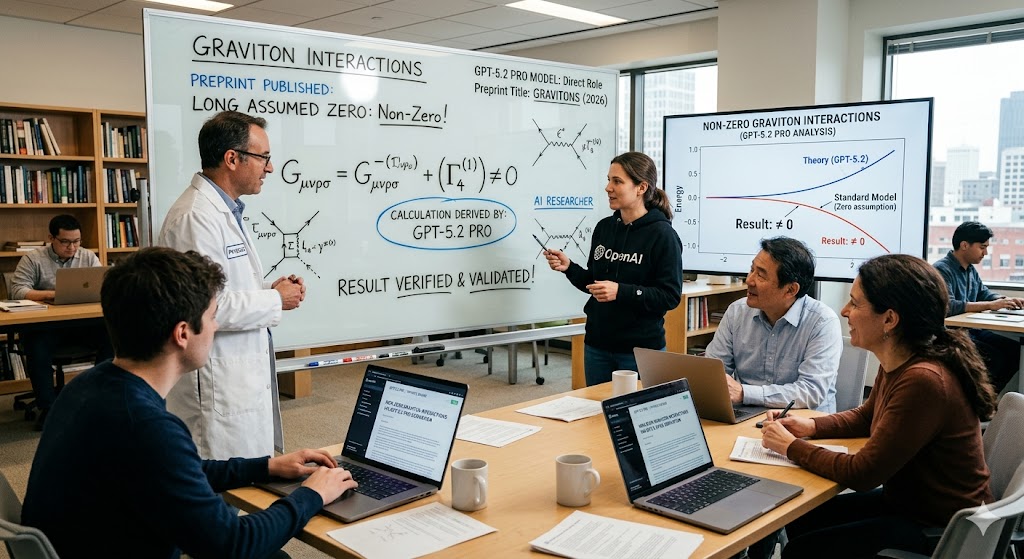
OpenAI researchers and top physicists have published a preprint showing that a class of graviton interactions long assumed to vanish can in fact be nonzero — with GPT-5.2 Pro playing a direct role in deriving and verifying the result.
A Result That Wasn't Supposed to Exist
In quantum gravity, physicists use mathematical objects called scattering amplitudes to calculate the probability that particles interact in particular ways. Rather than tracking every intermediate step of a collision through hundreds of diagrams, amplitudes encode the final observable outcomes in compact, elegant form. For decades, they've revealed hidden mathematical structure in physics that traditional calculations completely missed.
A new preprint from OpenAI and collaborators has overturned a long-standing assumption in this field: a class of graviton interactions known as single-minus amplitudes — long believed to vanish at tree level — turns out to be nonzero under well-defined conditions. The paper is titled "Single-minus graviton tree amplitudes are nonzero."
What Are Gravitons and Why Do They Matter?
Gravitons are the hypothetical quantum particles associated with gravity in quantum field theory — the gravitational equivalent of photons for electromagnetism. Unlike photons, gravitons have never been directly detected, but they are central to any attempt to build a mathematically consistent theory of quantum gravity.
Scattering amplitudes for gravitons describe how these particles interact — how they scatter off each other, how they combine, how they decay. Getting these calculations right is a foundational step toward understanding gravity at the quantum level, and potentially toward a unified theory of all forces.
The Single-Minus Problem
Every particle in a scattering process has a property called helicity — essentially the orientation of its spin relative to its direction of motion. In a "single-minus" configuration, one particle carries negative helicity while all others carry positive helicity.
Standard textbook arguments have long held that single-minus amplitudes for gravitons should equal zero at tree level — the simplest level of approximation where only the most direct interaction diagrams are considered. This wasn't a fringe assumption; it was textbook physics, widely relied upon in calculations across the field.
The new preprint shows this assumption is wrong. Single-minus graviton amplitudes are nonzero for certain kinematic configurations — specifically, "half-collinear" configurations that exist in what physicists call Klein space, or for complexified momenta. The paper derives a general formula using a Berends-Giele recursion relation and shows that in a restricted kinematic "decay region," the result simplifies to an elegant product of soft factors.
The Role of GPT-5.2 Pro
What makes this paper notable beyond its physics is the role AI played in producing it. GPT-5.2 Pro was used directly in deriving and verifying the results — not as a literature search tool or writing assistant, but as a collaborator in the mathematical work itself.
This follows a pattern OpenAI highlighted when launching Prism: in December 2025, a statistics paper used GPT-5.2 Pro to establish new proofs for a central axiom of statistical theory, with human researchers responsible only for prompts and verification. The graviton paper represents a similar model — but in a domain considerably harder and more unfamiliar to AI training data.
Who Wrote It
The paper is authored by a notable collaboration spanning elite institutions:
- Alfredo Guevara — Institute for Advanced Study
- Alexandru Lupsasca — Vanderbilt University and OpenAI
- David Skinner — University of Cambridge
- Andrew Strominger — Harvard University
- Kevin Weil — OpenAI (VP for Science)
Strominger in particular is one of the most decorated theoretical physicists alive, known for foundational work on string theory and black hole entropy. His involvement signals this isn't a peripheral result — it sits at the frontier of serious theoretical physics.
Why This Matters Beyond the Equations
The immediate significance is technical: correcting a widespread assumption in quantum gravity calculations matters for researchers working on amplitude methods, celestial holography, and related areas. Getting the mathematics right at tree level is foundational — errors here propagate into everything built on top.
But the broader significance is what this says about AI's role in theoretical science. If GPT-5.2 can contribute meaningfully to a result that overturns decades of textbook consensus in quantum gravity, the claim that 2026 will be AI's year in science starts to look less like a prediction and more like a description of something already underway.