OpenAI & Microsoft — Renegotiated, Clarified, and Built to Last
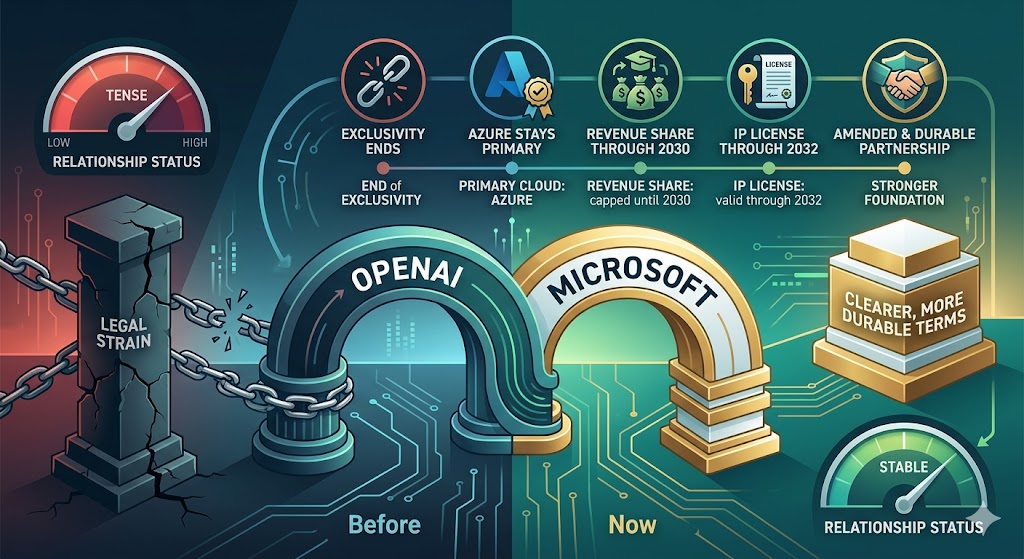
OpenAI and Microsoft have amended their landmark partnership: exclusivity ends, Azure stays primary, revenue share continues through 2030 with a cap, and the IP license runs through 2032. A relationship that was under legal strain is now built on clearer, more durable terms.
Why This Renegotiation Happened
The original Microsoft-OpenAI partnership was built for a different era — one where Microsoft had exclusive access to OpenAI's IP and products, and where the terms were tied to the undefined milestone of "achieving AGI." As OpenAI grew into one of the world's most valuable companies and began signing major deals with Amazon and others, those terms created real legal tension. In April 2026, both companies chose clarity over conflict.
"The rapid pace of innovation requires us to continue to evolve our partnership to benefit our customers and both companies," the two companies said jointly. The amended agreement is grounded in three principles: flexibility, certainty, and a focus on delivering the benefits of AI broadly.
What the New Terms Actually Say
The amended agreement resolves what had become a complex and contested arrangement into four clean commitments:
- Azure stays primary: Microsoft remains OpenAI's primary cloud partner, and OpenAI products will ship first on Azure — unless Microsoft cannot or chooses not to support the necessary capabilities.
- Multi-cloud is now explicit: OpenAI can now serve all its products to customers across any cloud provider. The exclusivity that had made the Amazon deal legally uncertain is gone.
- IP license through 2032: Microsoft will continue to have a license to OpenAI IP for models and products through 2032 — but it is no longer exclusive.
- Revenue share through 2030: OpenAI continues paying Microsoft at the same 20% rate, independent of OpenAI's technology progress, but now subject to a total cap. Crucially, Microsoft no longer pays a revenue share to OpenAI for Azure-hosted usage.
The AGI Clause Is Gone
One of the most unusual provisions of the original deal was that Microsoft's rights were tied to the moment OpenAI achieved AGI — a term with no agreed definition. That provision created uncertainty on both sides and complicated any long-term planning. The new agreement removes it entirely: the timeline is now calendar-based, running to 2030 and 2032 respectively, independent of any technical milestone.
Microsoft Remains a Major Investor
None of this changes Microsoft's financial stake in OpenAI. As of October 2025, Microsoft's investment in OpenAI Group PBC was valued at approximately $135 billion, representing roughly 27% on a diluted basis. Microsoft continues to participate directly in OpenAI's growth as a major shareholder — and OpenAI will continue paying $250 billion in committed Azure spend through the life of the deal.
What This Means in Practice
For enterprises, the amended deal is clarifying rather than disruptive. OpenAI products remain available on Azure — and now also through AWS and other providers. Companies can choose the cloud infrastructure that best fits their existing contracts and architecture without being locked into a single path to access OpenAI's models.
For Microsoft, losing exclusivity is offset by the certainty of a capped but guaranteed revenue stream through 2030, a continued IP license through 2032, and a major equity position in a company that continues to grow rapidly. It's a trade of exclusivity for stability — and for a company of Microsoft's scale, stability may be the better asset.
A Partnership Built to Last
"While this amendment simplifies the partnership, the work we're doing together remains ambitious," both companies said. From scaling gigawatts of new datacenter capacity to next-generation silicon collaboration to applying AI in cybersecurity — the operational depth of the Microsoft-OpenAI relationship extends well beyond the legal terms that govern it. The renegotiation didn't end the partnership; it put it on a foundation that can actually hold.