OpenAI Age Prediction — Teaching ChatGPT to Know Who It's Talking To
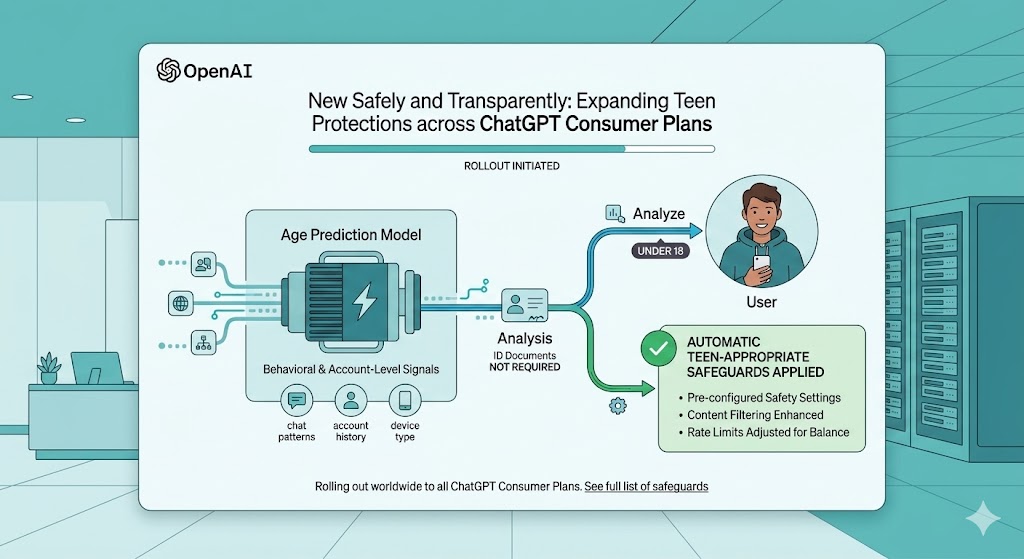
OpenAI is rolling out an age prediction model across ChatGPT consumer plans — using behavioral and account-level signals to identify users under 18 and automatically apply teen-appropriate safeguards, without requiring ID documents.
A Safety Problem That Couldn't Wait
More than half of all U.S. adolescents over the age of 13 now use generative AI — and for those under 13, usage is estimated at between 10 and 20 percent. These are not edge cases. They are a core and growing part of ChatGPT's user base, and for a long time, they were receiving the same experience as adults. OpenAI is now changing that — systematically, and at scale.
OpenAI is rolling out age prediction on ChatGPT consumer plans to help determine whether an account likely belongs to someone under 18, so the right experience and safeguards can be applied automatically. No ID required, no opt-in needed — the system works in the background.
How It Actually Works
The age prediction model evaluates a combination of behavioral and account-level signals. These include:
- How long the account has existed
- Typical times of day when the user is active
- Usage patterns over time
- The user's stated age at sign-up, when provided
This is not age verification (checking government documents) and not biometric age estimation (facial analysis). It is behavioral inference — drawing conclusions from patterns, the same way a platform might detect unusual activity or geographic anomalies. OpenAI is explicit that deploying the model in live conditions helps them observe which signals improve accuracy and refine the system continuously.
Crucially, when age information is uncertain or incomplete, the system defaults to the safer, under-18 experience. The burden of proof runs in the direction of protection, not convenience.
What Changes for Teens
When the model estimates an account belongs to someone under 18, ChatGPT automatically restricts exposure to a defined set of sensitive content categories, including:
- Graphic violence and gore
- Sexual, romantic, or violent role play
- Content promoting extreme beauty standards, unhealthy dieting, or body shaming
- Depictions of self-harm
- Viral challenges that could encourage risky or harmful behavior
- Content that promotes extreme behaviors or beliefs
This approach is grounded in academic research on child development, acknowledging known teen differences in risk perception, impulse control, peer influence, and emotional regulation. The restrictions aren't arbitrary — they map directly to the categories of harm most documented in adolescent psychology literature.
What If the System Gets It Wrong?
Adults incorrectly identified as minors can use the identity verification service Persona to restore full access. OpenAI does not see what is shared with Persona — the service deletes the data after verification, and OpenAI only receives confirmation that the user is 18 or older. Users who prefer not to go through age prediction at all can proactively verify their age with Persona to opt out of the prediction system entirely.
Parents Get Control Too
Beyond automated prediction, parents can customize their teen's experience further through parental controls. Options include setting quiet hours when ChatGPT cannot be used, managing features like memory and chat history, controlling whether the account contributes to model training, and receiving notifications when the system detects signs of acute distress. These controls require linking a parent account to the teen's account through a simple email invitation — available for users aged 13 and above.
The Context Behind the Urgency
OpenAI is not moving on teen safety in a vacuum. The company is named in multiple wrongful death lawsuits, faces an FTC probe into how AI chatbots affect children, and is simultaneously rolling out ads — which carry their own strict rules about targeting minors. The age prediction system sits at the intersection of all three pressures. Getting it right is both a moral obligation and a business necessity.
The rollout is currently underway globally, with the EU following in the coming weeks to account for regional regulatory requirements. Whether the behavioral inference approach proves robust enough to resist circumvention — and accurate enough to avoid systematically restricting adult users — will be the real test of whether this initiative lives up to its intent.