The Codex App — OpenAI's Command Center for the Multi-Agent Era
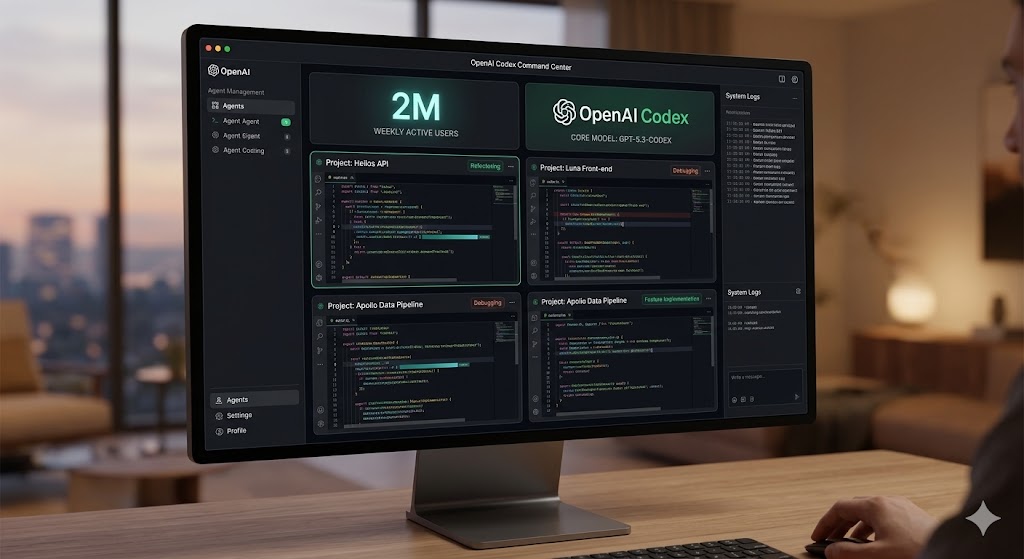
OpenAI has launched the Codex desktop app — a purpose-built command center for managing multiple AI coding agents in parallel. With 2 million weekly active users and GPT-5.3-Codex at its core, this is no longer just a coding tool.
From Agent to Command Center
When OpenAI first launched Codex in April 2025, it was a cloud-based software engineering agent — capable, but living inside ChatGPT's sidebar. By February 2026, Codex had grown into something the original launch didn't fully anticipate: a platform that needed its own dedicated interface. That interface is the Codex app.
The Codex app for macOS (and now Windows as of March 2026) is a purpose-built command center for managing multiple agents at once, running work in parallel, and collaborating with agents over long-running tasks. It's the difference between talking to one developer and managing an entire engineering team.
What Makes It Different
The core insight behind the Codex app is that modern AI-assisted development isn't a single conversation — it's a coordination problem. The app solves this with:
- Parallel agent threads organized by project, so you can switch between tasks without losing context
- Built-in worktree support — multiple agents can work on the same repo simultaneously without creating conflicts
- Isolated code copies per agent, letting you explore divergent approaches without risk to your main codebase
- Inline diff review — review changes in-thread, comment on them, or open directly in your editor
- Skills system — extend Codex beyond coding to tasks involving information gathering, writing, and custom workflows
The Skills feature is particularly significant. It lets teams bundle instructions, resources, and scripts so Codex can reliably connect to tools, follow team conventions, and complete tasks that go well beyond writing code. OpenAI demonstrated this by having Codex build a complete racing game — eight maps, multiple racers, in-game items — working independently using more than 7 million tokens.
The Model Powering It All
At launch, the Codex app runs on GPT-5.3-Codex — the most capable agentic coding model OpenAI has released. It advances both frontier coding performance and general reasoning in a single model that's also 25% faster than its predecessor. Notably, GPT-5.3-Codex was instrumental in creating itself: the Codex team used early versions to debug its own training, manage deployment, and diagnose evaluations — a milestone in AI-assisted AI development.
For real-time interactive sessions, GPT-5.3-Codex-Spark offers a lower-latency variant running on Cerebras hardware — approximately 15 times faster than earlier Codex versions, making it feel closer to a live pair-programmer than an asynchronous agent.
Security Built In
In March 2026, OpenAI also introduced Codex Security — an application-security agent that identifies and proposes fixes for software vulnerabilities. Tested on 1.2 million commits over 30 days, it identified nearly 800 critical vulnerabilities and more than 10,000 high-severity issues across major projects including Chromium, OpenSSL, and PHP. The agent validates suspected issues in sandboxed environments to prioritize by real-world impact and reduce false positives before suggesting patches.
The Numbers Are Hard to Ignore
By March 2026, Codex had grown to more than 2 million weekly active users. Daily usage had grown more than 10x since August 2025. Inside OpenAI itself, nearly all engineers now use Codex, merging 70% more pull requests per week compared to before. GPT-5-Codex served over 40 trillion tokens in just three weeks after launch — one of the fastest-growing models in OpenAI's history.
The competitive context matters too: Codex's usage had risen from roughly 5% of Claude Code's volume to approximately 40% between September 2025 and January 2026. The gap is closing fast — and the Codex app is a direct response to that competitive pressure.
The Bigger Picture: A Superapp on the Horizon
In March 2026, OpenAI confirmed plans to merge the ChatGPT app, Codex, and the Atlas browser into a single desktop superapp. The strategic logic is clear: fragmented tools create fragmented workflows. A unified environment where you can research, write, browse, and code — all with AI woven throughout — is the end state OpenAI is building toward.
For now, the Codex app is the clearest signal of that direction. It's not just a better way to write code. It's the prototype of how AI-native computing will actually feel.