Beyond Keywords: OpenAI Upgrades ChatGPT to Recognize Evolving Risks in Sensitive Chats
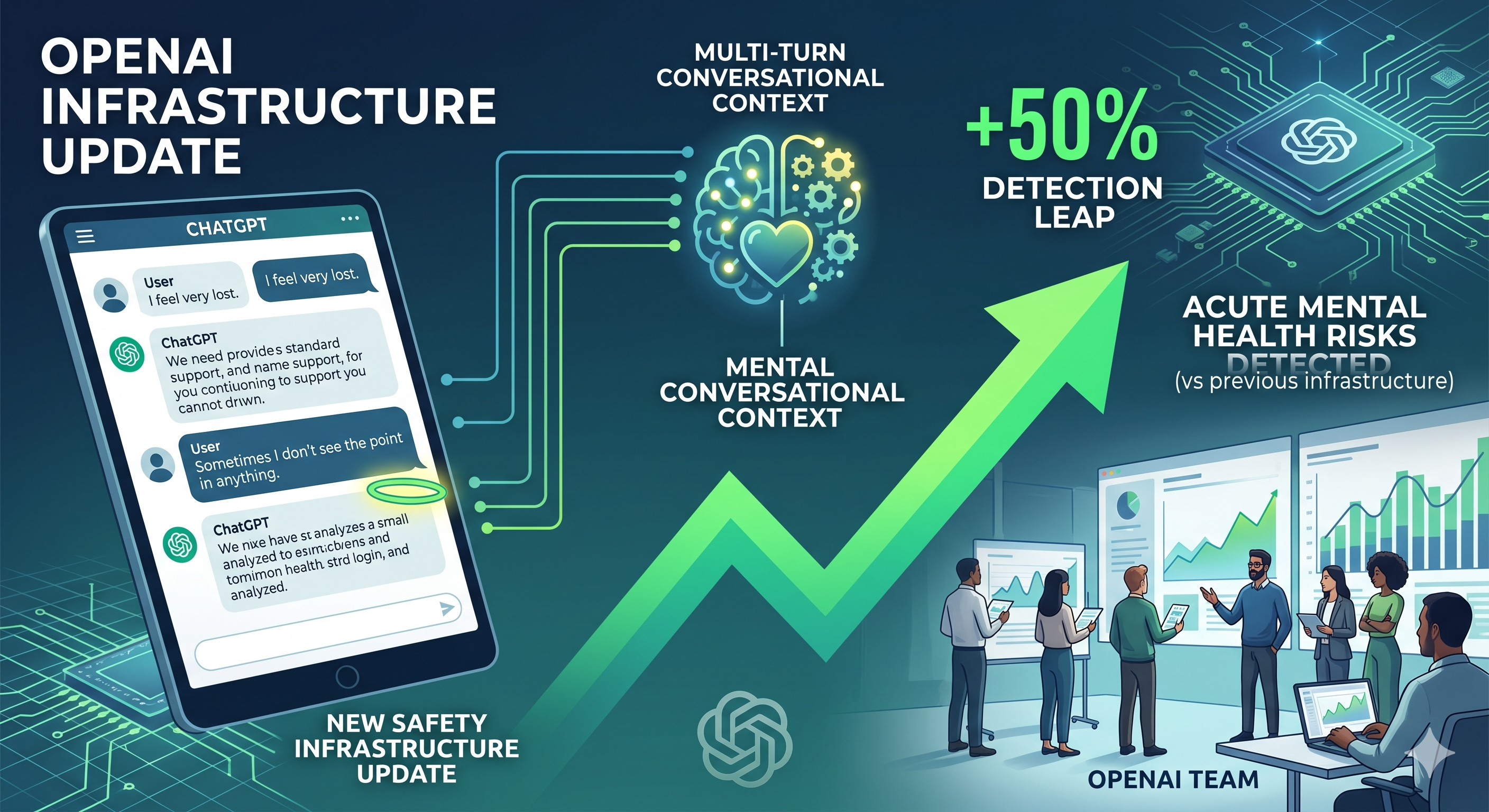
OpenAI details a major safety infrastructure update enabling ChatGPT to process multi-turn conversational context, achieving a 50% performance leap in detecting acute mental health risks.
The Nuance of Extended Dialogue
In Large Language Models, single-message moderation often falls short. A prompt that appears benign or ambiguous in isolation can take on an entirely different meaning when evaluated against preceding indicators of emotional distress or crisis. OpenAI has rolled out a framework engineered to connect these subtle, evolving cues across extended multi-turn interactions, shifting the paradigm from rigid keyword blocking to dynamic contextual comprehension.
The Core Mechanism: Safety Summaries
To enable contextual tracking without bloating the model’s active memory or compromising user data privacy, OpenAI introduced Safety Summaries. These are concise, highly targeted factual notes capturing safety-relevant indicators from earlier stages of a dialogue.
- Dedicated Architecture: A specialized model trained specifically for safety-oriented reasoning processes these summaries.
- Temporal Limitations: The factual notes are strictly short-term, kept only for a limited timeframe, and completely decoupled from long-term memory or user personalization layers.
- Validated Metrics: Across 4,000 internal evaluations, these summaries achieved an average safety relevance score of 4.93/5 and a factuality rating of 4.34/5.
Quantifiable Gains and Strategic Outcomes
Internal benchmarks reveal that this multi-turn context synthesis delivers a 50% improvement in safe-response accuracy during prolonged single-conversation scenarios involving high-risk categories like self-harm or suicide, alongside a 16% gain in harm-to-others detection. The model is now substantially better equipped to trigger protective protocols—such as de-escalation tactics, safe resource redirection, or specific prompt refusals—without introducing performance degradation into everyday, benign interactions.
The Shift to Dynamic Alignment
This deployment highlights a critical milestone in AI safety architecture. Moving beyond baseline defensive filters, the industry is witnessing the integration of structured reasoning layers designed specifically to handle the volatility of human emotion. Developed over two years alongside crisis and mental health specialists, the framework provides a blueprint for deploying high-agency systems that remain helpful in routine scenarios yet strictly bound within ethical boundaries when vulnerabilities surface.