Harness Engineering — How OpenAI Shipped 1 Million Lines of Code Without Writing a Single One
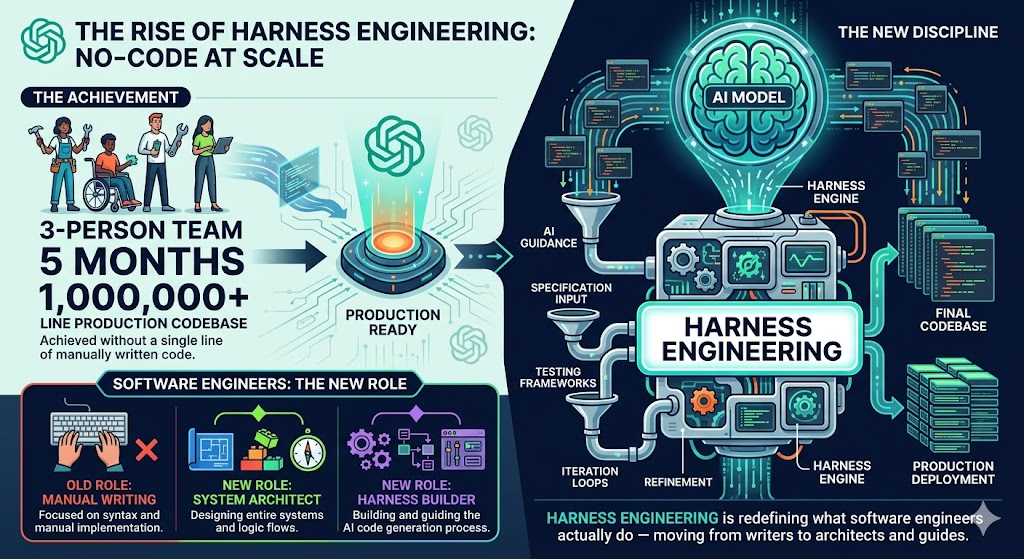
A three-person team at OpenAI built a million-line production codebase in five months — with zero manually written code. The discipline that made it possible is called Harness Engineering, and it's redefining what software engineers actually do.
The Experiment That Changed Everything
In August 2025, a three-person team at OpenAI started a new project with a single rule: no one writes code by hand. Every line would be generated by Codex, OpenAI's AI coding agent. Five months later, the result was staggering — roughly one million lines of production code, 1,500 merged pull requests, and a reported development speed approximately 10x faster than conventional engineering.
The interesting part isn't the output. It's what they learned about what actually makes AI agents reliable at scale — and the new discipline that emerged from it.
What Is a Harness?
The term comes from horse tack — the complete set of equipment that channels a powerful animal in the right direction. The metaphor is deliberate. Mitchell Hashimoto, co-founder of HashiCorp and creator of Terraform, crystallized the concept in early 2026: "Agent = Model + Harness."
The model provides reasoning capability — increasingly a commodity. The harness provides everything else: the rules, constraints, feedback loops, documentation structure, and validation mechanisms that make the model reliable and safe to deploy in production. Prompt engineering optimizes a single interaction. Harness engineering designs the environment that governs hundreds of autonomous decisions over hours.
The Four Problems They Hit
The OpenAI experiment didn't work well from the start. Early productivity was low because the agents kept failing in predictable ways. The team identified four recurring problems:
- Missing context: The agent didn't know what abstraction layer to use, what naming conventions applied, or where last week's architecture decision landed — so it guessed, and guessed wrong, repeatedly.
- Weak tooling: Without proper tool integration, the agent couldn't recover from errors or verify its own output.
- Architectural drift: As code volume grew, agents began replicating poor patterns and accumulating technical debt — what the team called entropy.
- Self-evaluation failure: Agents are systematically bad at assessing their own output, often wrapping up tasks prematurely as context windows filled.
Each problem had the same solution: don't fix the prompt. Fix the environment.
How the Harness Was Built
The primary instinct — a single AGENTS.md file containing every convention and rule — failed immediately. A single blob doesn't lend itself to mechanical checks, so drift was inevitable. Instead, the team built a structured knowledge architecture:
- A short AGENTS.md (~100 lines) serving as a table of contents, not an encyclopedia
- A structured
docs/directory as the single source of truth - Architecture documentation providing a top-level map of domains and package layering
- Cross-linked design documents enforced mechanically with linters and CI validation
The key insight: writing a rule in documentation still allows the agent to violate it. Encoding it at the system level prevents that up front. Dependency direction, for example, was enforced mechanically. When generated code violated architectural direction, the linter blocked it and immediately injected correction instructions directly into the agent's context — enabling self-repair without human intervention.
Humans Steer. Agents Execute.
The role of the three engineers wasn't to write code — it was to design the system that made code-writing reliable. When something failed, the fix was almost never "try harder" or "improve the prompt." Instead, the team asked: what capability is missing, and how do we make it both legible and enforceable for the agent?
This is the fundamental shift harness engineering introduces. Traditional debugging is reactive: something broke, fix it. Harness engineering is structural: something broke, build a system to prevent it from happening again. Every mistake becomes a permanent improvement to the environment — not a one-time patch.
A New Discipline, Named in 90 Days
OpenAI published its findings in February 2026. Within weeks, Anthropic published three separate engineering papers on the same concept. ThoughtWorks formalized a framework. Philipp Schmid at Hugging Face called it "the most important discipline of 2026." A new engineering field had materialized in under three months.
The speed of adoption signals something important: harness engineering doesn't introduce a new idea so much as it names a problem every engineer building AI agents has already hit. The agent isn't the hard part. The environment is.
What It Means for Software Engineers
The three OpenAI engineers weren't replaced — they changed what they do. From people who write code, to people who design systems and control quality. The craft remains; the medium shifts.
If this trajectory holds, the most valuable engineering skill in an agentic world isn't the ability to write code — it's the ability to design environments where AI writes code reliably. That requires deep understanding of system architecture, feedback loop design, constraint encoding, and failure mode analysis. None of those are new skills. Their importance just changed dramatically.