OpenAI's Pentagon Deal — Red Lines, Real Risks, and the Trust Problem
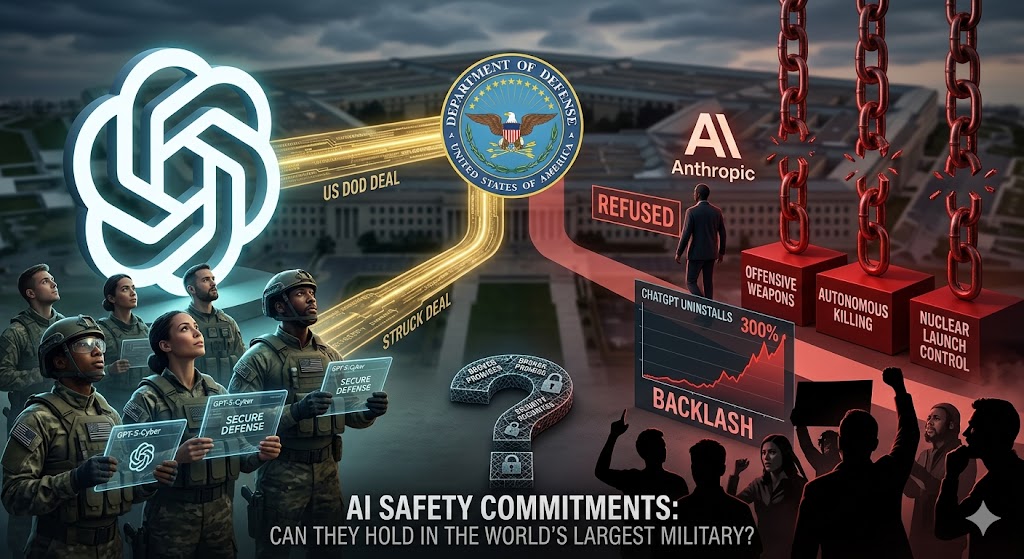
OpenAI struck a deal with the U.S. Department of Defense after Anthropic refused. With three stated red lines and a backlash that spiked ChatGPT uninstalls by 300%, the agreement raises hard questions about whether AI safety commitments can hold inside the world's largest military.
The Deal That Shocked the Industry
In late February 2026, the U.S. Department of Defense designated Anthropic as a "supply chain risk" after the company refused to drop its restrictions on the use of AI for mass domestic surveillance and fully autonomous weapons. Within days, OpenAI announced it had reached its own deal to deploy AI models in classified Pentagon environments — filling the gap Anthropic had refused to fill.
Sam Altman, OpenAI's CEO, would later admit on X that the initial agreement had been "definitely rushed" and that "the optics don't look good." But the deal was done — and the fallout was immediate.
The Three Red Lines OpenAI Drew
OpenAI published a statement outlining three non-negotiable limits for use of its technology:
- No mass domestic surveillance — AI systems cannot be used to surveil U.S. citizens at scale
- No directing autonomous weapons systems — human responsibility for the use of force must remain
- No high-stakes automated decisions without human oversight — AI cannot replace human judgment in life-or-death contexts
OpenAI argued its contract provides better guarantees than earlier agreements, stating: "We retain full discretion over our safety stack, we deploy via cloud, cleared OpenAI personnel are in the loop, and we have strong contractual protections." The company also confirmed the NSA would not be permitted to use OpenAI tools under this agreement without a separate deal.
The Anthropic Question No One Could Answer
The most awkward aspect of the announcement: Anthropic had reportedly refused the deal over the exact same two conditions — no mass surveillance, no autonomous weapons. Yet the Pentagon accepted these terms from OpenAI while designating Anthropic a security risk for insisting on them.
OpenAI acknowledged the contradiction directly: "We don't know why Anthropic could not reach this deal, and we hope that they and more labs will consider it." That sentence revealed as much as it concealed — suggesting the dispute may have been as much about politics and leverage as about the substance of the restrictions.
The Backlash Was Immediate and Significant
The public reaction was swift. ChatGPT uninstalls rose nearly 300% after the deal was announced, with users and employees alike expressing concern that OpenAI had crossed a line it had previously committed not to cross. Altman held an internal all-hands meeting where he acknowledged the backlash — but also confirmed that Defense Secretary Pete Hegseth would retain ultimate authority over how the Pentagon uses the contract.
Critics pointed out that Altman's assurances ultimately rested on trust — trust in OpenAI engineers to enforce compliance across a department of over 2 million service members and 800,000 civilian personnel. That's a lot of weight to place on contractual language and a cloud deployment architecture.
The Surveillance Loophole Critics Flagged
After the initial announcement, legal analysts noted that the agreement's reference to compliance with Executive Order 12333 — which governs foreign intelligence collection but has historically been used to justify large-scale data collection on Americans — may have created a significant gap in the surveillance prohibition. In response, Altman published an updated memo clarifying that the AI system "shall not be intentionally used for domestic surveillance of U.S. citizens," citing the Fourth Amendment, the National Security Act of 1947, and FISA.
Critics from the Electronic Frontier Foundation argued this language was still insufficient — that "secret agreements and technical assurances have never been enough to rein in surveillance agencies, and they are no substitute for strong, enforceable legal limits and transparency."
Architecture as the Real Safeguard
OpenAI's head of national security partnerships Katrina Mulligan pushed back against critics who focused on contract language, arguing that deployment architecture matters more: "By limiting our deployment to cloud API, we can ensure that our models cannot be integrated directly into weapons systems, sensors, or other operational hardware." The argument is that technical constraints — not just written commitments — are the real line of defense.
Whether that distinction holds in practice, under the pressures of a defense bureaucracy with its own institutional interests and a political leadership that has shown little hesitation in pushing AI boundaries, is a question that won't be answered in a blog post.
The Deeper Stakes
This deal matters beyond OpenAI. It represents the first major test of whether AI companies can maintain meaningful safety commitments when the customer is the most powerful military on earth, operating in classified environments where independent verification is impossible. Anthropic drew a line and paid a severe price. OpenAI drew a similar line — on paper — and struck the deal. The industry is now watching to see which approach proves more durable.