Inside OpenAI's Data Agent — Two Engineers, 4,000 Users, 600 Petabytes
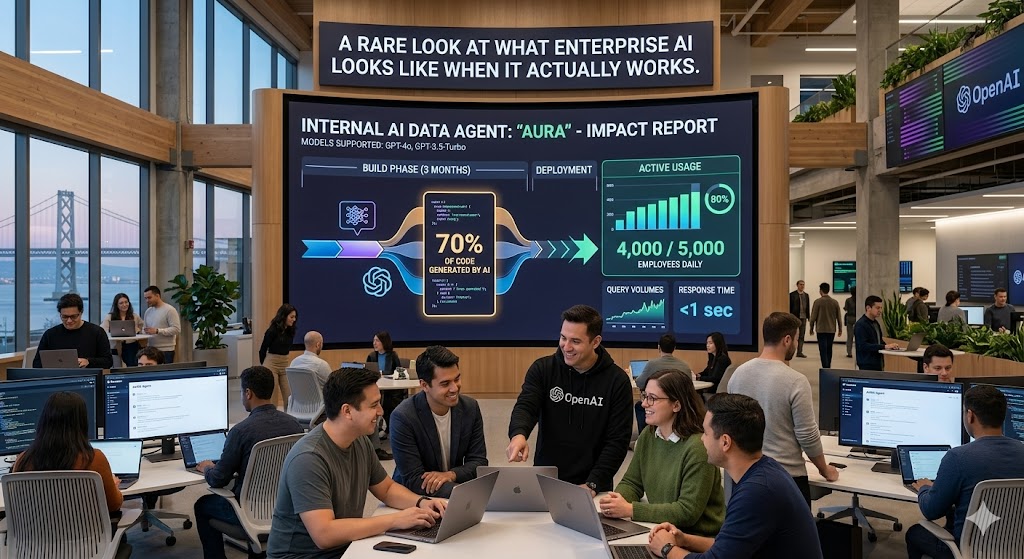
OpenAI built an internal AI data agent in three months — 70% of its code written by AI itself — that now serves 4,000 of its 5,000 employees daily. A rare look at what enterprise AI looks like when it actually works.
The Most Consequential AI at OpenAI Isn't a Model
OpenAI spends billions training frontier models that make headlines. But internally, one of its most impactful AI deployments is something far more unglamorous: a data agent built by just two engineers in three months, with 70% of its code written by AI itself. It now serves more than 4,000 of the company's roughly 5,000 employees every single day.
The problem it solves is one every large organization knows: OpenAI's internal data platform spans more than 600 petabytes across 70,000 datasets. Even for experienced data scientists, simply finding the right table can consume hours. For non-technical staff, getting a data-backed answer to a business question was effectively out of reach.
From Hours of SQL to Minutes in Slack
The agent fundamentally changes that workflow. A finance analyst now types a question in plain English into Slack and receives a finished chart within minutes. OpenAI's internal estimates suggest the tool saves two to four hours of work per query. But the more important impact is qualitative: the agent surfaces analyses that employees wouldn't have attempted at all under the old workflow — questions that simply never got asked because the effort wasn't worth it.
The interface is intentionally simple and embedded where employees already work: Slack, a web UI, IDEs, the Codex CLI, and OpenAI's internal ChatGPT app. Ask a question in natural language, receive structured output — charts, dashboards, or long-form analytical writeups. And critically, this isn't reserved for data specialists. Engineering, Finance, Go-to-Market, Research, and non-technical functions all use it daily.
Why Most Data Agents Fail — and How This One Doesn't
The reason most AI data tools produce wrong answers isn't the model — it's missing context. OpenAI's agent is built on five layers of contextual grounding that prevent the classic "confident wrong answer" failure mode:
- Table usage metadata: Deep schema understanding with lineage and usage patterns to improve query relevance
- Human annotations: Domain expert insights that add meaning beyond raw structural metadata
- Codex-powered code enrichment: Crawls actual data pipelines and jobs to understand how datasets were constructed and what they semantically represent
- Institutional knowledge: Integrates internal documentation from Slack, Notion, and Google Docs — capturing business event context and metric definitions
- Memory and learning: Continuously updates based on corrections and new discoveries, improving accuracy over time
This layered approach is what separates the agent from a chatbot that writes SQL. It knows what "active user" means at OpenAI specifically — including regional variations in definition. It knows which table is the canonical source for a given metric. It shows its work, exposing the SQL and reasoning so users can verify rather than just trust.
Security Without Complexity
One of the most elegant design decisions: the agent doesn't bypass access control. It enforces the same permissions that already govern internal data access — users only see data they're already allowed to see. This avoids the nightmare scenario of an AI system becoming a shadow data access layer that circumvents existing governance.
The system uses OpenAI's Evals API to continuously monitor output quality against ground-truth results, acting as ongoing unit testing for an analytics agent. When outputs drift, the evaluation catches it before it becomes a trust problem.
The Tools Anyone Can Replicate
What makes this story particularly relevant is what OpenAI used to build it: Codex, GPT-5, the Evals API, and the Embeddings API — the same tools available to any developer building on the OpenAI platform today. The agent isn't a proprietary system locked inside OpenAI. It's a blueprint built with public infrastructure.
The key design lessons OpenAI shared: redundant tools hurt agent quality and should be simplified; high-level guidance outperforms prescriptive step-by-step instructions; and context is a system to be engineered, not a prompt to be tuned.
What "AI at Scale" Actually Looks Like
This isn't a demo. It isn't a pilot. It's infrastructure — quietly running behind 80% of the company's daily workflows, saving thousands of hours per week, and enabling decisions that previously required a data science ticket and a three-day wait. No flashy interface. No breakthrough capability. Just the right question getting the right answer, faster than before.
For teams building internal AI tools, OpenAI's data agent is the clearest public blueprint yet for what it actually takes: not better models, but better context, better guardrails, and better evaluation. The hard part was never the AI. It was the governance.