Introducing Personal Finance in ChatGPT: The Next Frontier of Conversational Wealth Management
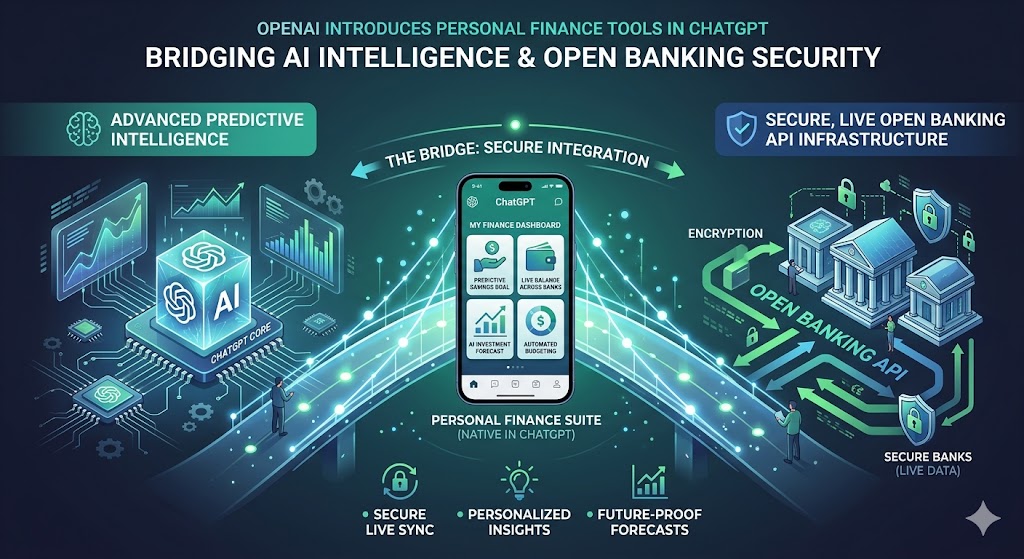
OpenAI has rolled out a suite of personal finance tools native to ChatGPT, bridging the gap between advanced predictive intelligence and secure, live Open Banking API infrastructures.
The Convergence of AI and Personal Wealth
For years, personal finance management apps have relied on static tracking—graphs that show where money was spent, but offer little guidance on future optimization. OpenAI has disrupted this paradigm by embedding an active, predictive personal finance framework directly within ChatGPT. This development marks a milestone where large language models transition from informative advisors into autonomous analytical agents capable of processing real-time financial data.
Secure Integration via Open Banking APIs
The core infrastructure enabling this feature relies heavily on secure Open Banking protocols. Rather than requiring users to manually input spreadsheet data, ChatGPT now securely links with financial accounts through authenticated API aggregators. This technical pipeline guarantees several enterprise-grade security metrics:
- Read-Only Access: The network architecture explicitly prevents any transaction initiation, eliminating the risk of unauthorized fund movements.
- End-to-End Encryption: Financial telemetry remains encrypted throughout transit and resting phases, satisfying stringent institutional compliance criteria.
- Zero-Data Retention for Training: OpenAI confirms that user financial records processed through this feature are strictly excluded from foundational model training cycles.
The Shift Toward Predictive Financial Planning
The operational capability of ChatGPT goes far beyond simple bookkeeping. By utilizing advanced contextual reasoning, the model cross-references transaction histories with macro-economic indicators to generate highly granular cash-flow models. Users can simulate complex financial scenarios, such as mapping long-term debt amortization schedules or projecting investment yields under shifting interest rate regimes. The system detects anomalous spending behaviors and offers optimizing alternatives without requiring user prompts.
Disrupting the Traditional Fintech Ecosystem
This integration presents a significant structural challenge to established financial tracking applications. By lowering cognitive friction and automating the synthesis of disparate accounts into a singular, conversational interface, OpenAI is rapidly absorbing the value chain of traditional personal finance managers. The value proposition is no longer the aggregate view of data, but the immediate, actionable intelligence synthesized from it.