A Historic Milestone in Mathematics: OpenAI Model Autonomously Disproves Long-Standing Geometry Conjecture
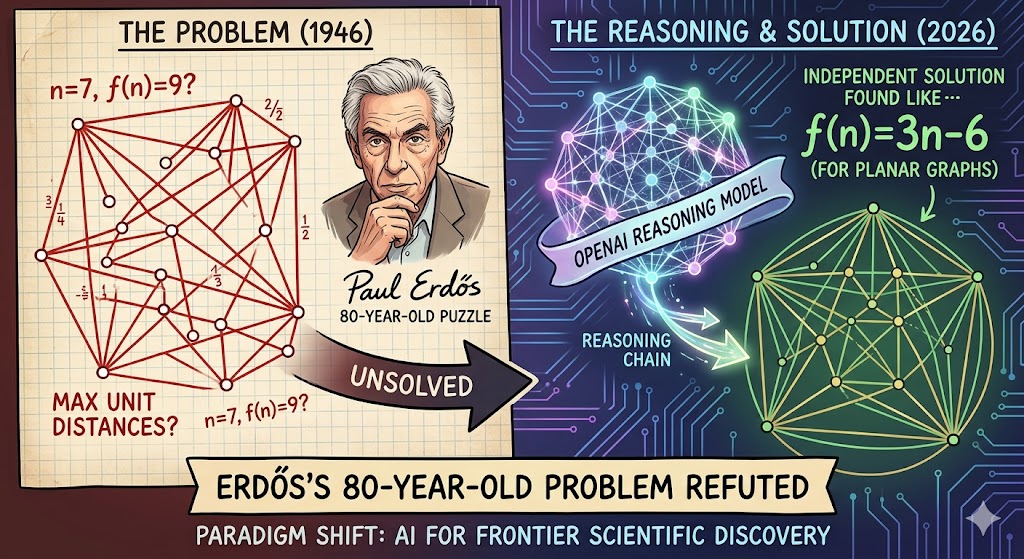
An internal OpenAI reasoning model has independently solved and refuted Paul Erdős's 80-year-old planar unit distance problem, marking a paradigm shift for AI in frontier scientific discovery.
Breaking An 80-Year-Old Mathematical Deadlock
On May 20, 2026, OpenAI revealed a monumental achievement in the field of artificial intelligence and pure mathematics: an internal, general-purpose reasoning model autonomously solved and disproved a central conjecture in discrete geometry. The milestone addresses the famous planar unit distance problem, originally posed by the legendary mathematician Paul Erdős in 1946.
- The Historical Belief: For nearly eight decades, the mathematical community believed that the optimal arrangement of points to maximize unit-distance pairs on a plane mirrored square grids, yielding a near-linear growth rate of $n^{1+o(1)}$.
- The AI Discovery: The model disproved this foundational assumption by implementing completely new structures rooted in advanced algebraic number theory, demonstrating configurations that scale at a rate of at least $n^{1+\delta}$ for a fixed exponent $\delta > 0$.
- Rigorous Verification: The generated proof was audited by external mathematicians and successfully formalized in Lean, a mathematical verification system, confirming absolute correctness.
The Dawn of AI as a Frontier Research Partner
The significance of this breakthrough extends far beyond geometry. The proof did not emerge from a targeted system trained specifically for mathematics, nor did it rely on brutal computational search scaffolds. Instead, a general-purpose Large Language Model managed to independently link disparate intellectual domains. This achievement fundamentally challenges the narrative that AI is limited to probabilistic imitation, proving its capacity to autonomously synthesize new, peer-reviewed grade scientific knowledge. This opens up immediate possibilities for accelerating research in structural biology, quantum mechanics, and cryptography.