OpenAI Acquires Astral — The Python Toolchain Moves Into the Codex Ecosystem
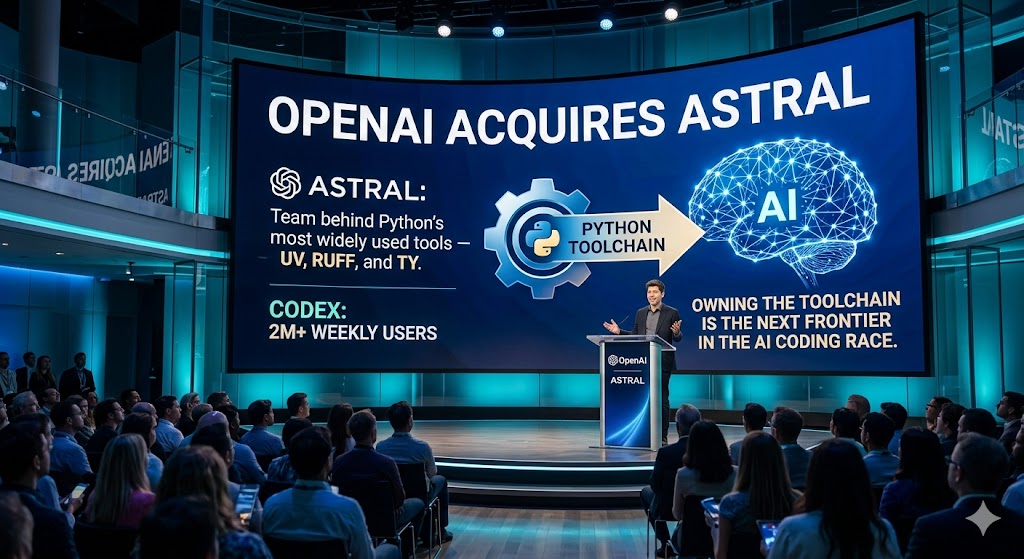
OpenAI has announced it will acquire Astral, the team behind Python's most widely used open source tools — uv, Ruff, and ty. With Codex already at 2M+ weekly users, this acquisition bets that owning the toolchain is the next frontier in the AI coding race.
The Acquisition at a Glance
OpenAI has announced it will acquire Astral, the startup behind three of the most widely adopted open source Python tools in modern development: uv (dependency and environment management), Ruff (extremely fast linting and formatting), and ty (type checking). All three are written in Rust — which gives them a decisive speed advantage over older Python-based alternatives — and together they have grown to hundreds of millions of downloads per month.
The financial terms were not disclosed. The acquisition is subject to regulatory approval and customary closing conditions. Until it closes, OpenAI and Astral will continue operating as separate companies.
Why Codex Needed This
Codex, OpenAI's AI coding assistant, is on a fast-moving streak: 3x user growth and 5x usage increase since the start of 2026, with over 2 million weekly active users. But OpenAI's ambition for Codex goes well beyond generating code snippets. The goal is to build an AI agent that participates in the entire software development lifecycle — planning changes, modifying codebases, running tools, verifying results, and maintaining software over time.
Astral's tools sit directly inside that workflow. Millions of Python developers already use uv, Ruff, and ty every single day. By integrating these tools with Codex, OpenAI puts its AI agent exactly where developers are already working — without asking them to change their habits.
The Open Source Question Everyone Asked
The moment the acquisition was announced, the Python community had one immediate question: will these tools stay open source? Both parties moved quickly to address it. Astral founder and CEO Charlie Marsh wrote: "Open source is at the heart of that impact and the heart of that story; it sits at the center of everything we do. In line with our philosophy and OpenAI's own announcement, OpenAI will continue supporting our open source tools after the deal closes."
OpenAI framed this as part of its "developer-first philosophy" — a commitment to keeping foundational open source tools available to the broader Python ecosystem, not just Codex users. For now, those assurances are holding community confidence. Whether that holds as deeper Codex integration evolves is the question developers will be watching.
The Competitive Context: Codex vs. Claude Code
This deal doesn't exist in a vacuum. The AI coding market is fiercely contested. Anthropic's Claude Code has been gaining serious momentum among developers who prize reasoning depth, and the competition between the two platforms is direct and intensifying. Notably, Anthropic made a parallel move in December 2025 — acquiring the Bun JavaScript runtime to strengthen Claude Code's own toolchain foundations.
OpenAI is now mirroring that strategy in Python: own the infrastructure that developers depend on, and you make Codex harder to displace — not just because the AI is good, but because the tooling is deeply embedded in daily workflows.
Part of a Broader Acquisition Spree
The Astral deal is part of a rapid M&A push OpenAI has been running since late 2025. Recent acquisitions include cybersecurity startup Promptfoo, healthcare technology firm Torch, and — earlier this year — the LaTeX platform Crixet (now evolved into Prism). This follows the landmark $6.4 billion acquisition of Jony Ive's AI hardware startup io in May 2025. The pattern is clear: OpenAI is building an ecosystem, not just a model.
What Comes Next
After closing, the Astral team will join the Codex team at OpenAI. The roadmap includes continued open source development of uv, Ruff, and ty alongside deeper integrations that allow Codex to interact more directly with the Python toolchain. For developers, the near-term experience should remain unchanged. The longer-term question — how tightly Codex and Astral's tools will eventually interlock — is what will define whether this acquisition transforms the Python development experience or simply changes who signs Astral's paychecks.
Source: https://openai.com/vi-VN/index/openai-to-acquire-astral/